Blog

STP AMC in Kolkata: What Should an Annual Maintenance Contract Include?

An Annual Maintenance Contract can provide a structured approach to maintaining a sewage treatment plant. Instead of waiting for equipment failure, property owners and facility managers can arrange scheduled maintenance and technical support.

For organizations searching for STP AMC in Kolkata, it is important to understand what should be included in a professional maintenance agreement.

What Should an STP AMC Include?

A comprehensive STP AMC may include:

1. Preventive Maintenance
Routine inspection of pumps, blowers, motors, electrical systems and treatment components.

2. Process Monitoring
Monitoring the operation of different treatment stages and identifying unusual performance.

3. Equipment Inspection
Checking critical equipment for wear, abnormal noise, vibration or performance issues.

4. Troubleshooting
Technical assistance when the plant develops operational problems.

5. Cleaning and Maintenance
Regular attention to tanks, filters, pipelines and associated components as required.

6. Operational Support
Assistance with day-to-day plant operation and process management.

7. Upgradation Recommendations
Identification of components or systems that may require improvement.

Why Choose STP AMC?

A planned AMC can help organizations maintain better operational continuity and reduce the possibility of avoidable failures.

Narayan Solutions provides STP AMC and O&M services in Kolkata for commercial, residential, institutional and industrial requirements.

What Should You Check Before Signing an AMC?

Before selecting an STP maintenance company, check:

  • Scope of maintenance
  • Frequency of visits
  • Preventive maintenance schedule
  • Emergency support
  • Equipment coverage
  • Consumables and spare-parts terms
  • O&M responsibilities
  • Reporting methodology
  • Upgradation support

If you are looking for a professional STP AMC company in Kolkata, Narayan Solutions can provide customized maintenance and O&M solutions.

Contact Narayan Solutions

Communication Office: 35, Rajendra Banerjee Road, Behala, Kolkata – 700034
Communication Office: Plot No: 47, R.R. Plot, Prasanta Sur Nagar, Nonadanga, Kolkata – 700105
Branch Office: Tagira, Ranital, Bhadrak, Odisha – 756111
Call: 9831038044 / 7044093759 / 7044037375
Email: solutionnarayan@gmail.com
Website: narayan-solutions.com

STPAMC | STPAnnualMaintenance | STPMaintenanceKolkata | STPOandM | WastewaterTreatment | STP annual maintenance contract Kolkata | STP maintenance company Kolkata | STP O&M Kolkata | STP service provider Kolkata

Sewage Treatment Plant Maintenance in Kolkata: Why Regular STP O&M Matters

A sewage treatment plant must be operated and maintained consistently to deliver reliable treatment performance. Simply installing an STP is not enough. Pumps, blowers, aeration systems, biological processes, sludge systems and other components require regular monitoring.

Businesses and property managers looking for sewage treatment plant maintenance in Kolkata should therefore consider preventive maintenance and professional O&M support.

What Does STP Maintenance Include?

Depending on plant design and operational requirements, maintenance may include:

  • Equipment inspection
  • Pump and blower monitoring
  • Aeration-system inspection
  • Electrical-panel checks
  • Sludge-management monitoring
  • Filter and media inspection
  • Cleaning and housekeeping
  • Process monitoring
  • Troubleshooting
  • Preventive maintenance
  • Emergency repair support

Why Preventive Maintenance Matters

Unexpected STP failures can create operational difficulties for residential and commercial properties. Preventive maintenance helps identify developing problems before they become major failures.

For example, unusual pump vibration, reduced blower performance or changes in the treatment process may indicate that attention is required.

STP O&M Services in Kolkata

Professional STP operation and maintenance services in Kolkata can include regular plant supervision, process monitoring and technical maintenance.

Narayan Solutions provides STP O&M and AMC solutions designed for organizations that require dependable wastewater treatment support.

STP Repair and Upgradation

An existing STP may experience reduced performance because of ageing equipment, inadequate maintenance, changing wastewater characteristics or outdated process systems.

In such situations, STP plant repair, retrofit and upgradation services can help improve the existing system.

Who Needs STP Maintenance?

STP maintenance services can be useful for:

  • Apartment complexes
  • Residential societies
  • Hotels
  • Hospitals
  • Commercial buildings
  • Educational institutions
  • Industrial facilities
  • Corporate campuses

If you are searching for STP maintenance services in Kolkata, Narayan Solutions can assist with maintenance, AMC, O&M, troubleshooting and upgradation requirements.

Contact Narayan Solutions

Communication Office: 35, Rajendra Banerjee Road, Behala, Kolkata – 700034
Communication Office: Plot No: 47, R.R. Plot, Prasanta Sur Nagar, Nonadanga, Kolkata – 700105
Branch Office: Tagira, Ranital, Bhadrak, Odisha – 756111
Call: 9831038044 / 7044093759 / 7044037375
Email: solutionnarayan@gmail.com
Website: narayan-solutions.com

STPMaintenance | SewageTreatmentPlant | STPOandM | KolkataSTP | STPServices | NarayanSolutions | STP maintenance services Kolkata | STP operation and maintenance Kolkata | STP service provider Kolkata | STP plant repair Kolkata

Best STP Maintenance Company in Kolkata: Reliable STP O&M & AMC Services

A properly functioning Sewage Treatment Plant (STP) is essential for residential complexes, hotels, hospitals, commercial buildings, institutions and industrial facilities. Regular maintenance ensures that the plant continues to treat wastewater efficiently while reducing operational problems and unexpected breakdowns.

For organizations searching for the best STP maintenance company in Kolkata, choosing an experienced service partner is important. Narayan Solutions provides professional STP maintenance, operation and maintenance (O&M), annual maintenance contracts (AMC), repair, retrofitting and plant upgradation solutions.

Why Is STP Maintenance Important?

An STP contains several interconnected mechanical, electrical and biological treatment processes. Problems with aeration, pumps, blowers, sludge handling, filtration or biological treatment can affect overall plant performance.

Regular STP maintenance can help with:

  • Better treatment performance
  • Reliable plant operation
  • Preventive identification of equipment problems
  • Reduced unexpected breakdowns
  • Better sludge management
  • Improved operational efficiency
  • Longer equipment life
  • More consistent treated-water quality

Professional STP O&M Services in Kolkata

Narayan Solutions can support clients with STP operation and maintenance in Kolkata, including routine inspections, equipment monitoring, process optimisation, troubleshooting and preventive maintenance.

The company also provides STP AMC services in Kolkata for organizations that prefer structured long-term maintenance support instead of arranging emergency repairs whenever a problem occurs.

STP Maintenance for Different Facilities

Professional STP maintenance can be required by:

  • Residential complexes
  • Housing societies
  • Hotels and resorts
  • Hospitals
  • Schools and colleges
  • Shopping and commercial complexes
  • Industrial facilities
  • Institutional campuses

STP Upgradation and Retrofitting

Older plants may require equipment replacement, process modifications or capacity-related improvements. Narayan Solutions provides STP plant upgradation and retrofit services to help improve existing systems.

Choose a Professional STP Service Provider

If you are searching online for a reliable STP maintenance company in Kolkata, evaluate the provider based on technical capability, maintenance methodology, response support and experience with different treatment technologies.

Narayan Solutions offers STP design, turnkey execution, maintenance, AMC, O&M and upgradation solutions.

Contact Narayan Solutions

Communication Office: 35, Rajendra Banerjee Road, Behala, Kolkata – 700034
Communication Office: Plot No: 47, R.R. Plot, Prasanta Sur Nagar, Nonadanga, Kolkata – 700105
Branch Office: Tagira, Ranital, Bhadrak, Odisha – 756111
Call: 9831038044 / 7044093759 / 7044037375
Email: solutionnarayan@gmail.com
Website: narayan-solutions.com

STPMaintenanceKolkata | STPAMC | STPOandM | SewageTreatmentPlant | NarayanSolutions | KolkataWaterTreatment | STP maintenance services Kolkata | STP AMC Kolkata | STP service provider Kolkata | sewage treatment plant maintenance Kolkata | STP O&M services Kolkata

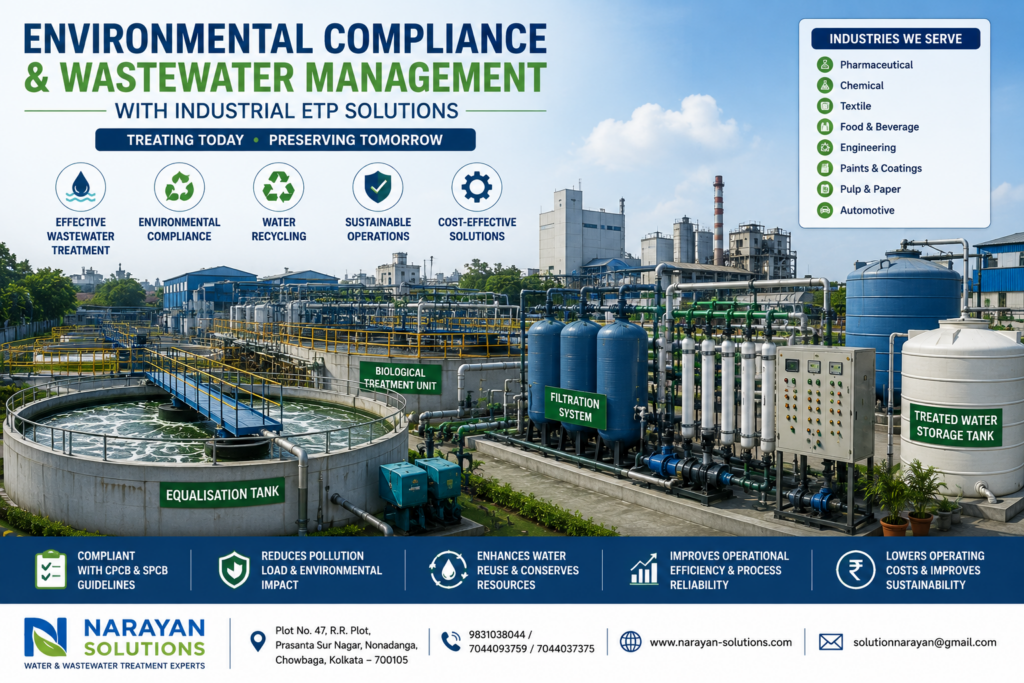
Environmental compliance and industrial wastewater management using an ETP plant

Environmental Compliance and Wastewater Management: What Industries Need to Know

Industrial development is essential for economic growth, but manufacturing and processing activities can generate wastewater containing suspended solids, organic matter, oils, chemicals, nutrients and industry-specific contaminants. Effective environmental compliance and wastewater management are therefore essential for responsible industrial operations.

A properly designed Effluent Treatment Plant (ETP) can help industries treat process wastewater, reduce pollutant loads and manage treated effluent according to applicable requirements and intended reuse or discharge conditions.

In West Bengal, industries may need to obtain appropriate Consent to Establish (CTE) and Consent to Operate (CTO) from the West Bengal Pollution Control Board (WBPCB), depending on their category and activity. WBPCB’s current service information includes CTE and CTO processes for Red, Orange and Green industries in specified circumstances.

Why Wastewater Management Matters for Industries

Industrial wastewater should not be treated as an unavoidable by-product. With the right treatment strategy, it can be managed as part of a broader environmental and resource-management programme.

Poorly managed effluent can create risks for water bodies, soil, surrounding communities and industrial operations. Effective treatment helps industries control pollution and establish a more systematic approach to wastewater handling.

For industries operating in West Bengal, regulatory compliance should be considered during project planning, plant design, operation and expansion.

What Is an Effluent Treatment Plant?

An Effluent Treatment Plant (ETP) is a treatment system designed to process industrial wastewater before appropriate discharge or reuse.

Depending on the industry and wastewater characteristics, an ETP may combine:

  • Screening and preliminary treatment
  • Collection and equalisation
  • Oil and grease removal
  • pH correction
  • Coagulation and flocculation
  • Primary clarification
  • Biological treatment
  • Secondary clarification
  • Filtration and tertiary treatment
  • Disinfection
  • Sludge handling

The treatment configuration should be based on wastewater analysis, flow rate, pollutant characteristics and the required treated-water quality.

Understanding Environmental Compliance

Environmental compliance is more than simply installing an ETP. Industries should understand the permissions, standards, monitoring requirements and operating conditions applicable to their particular activity.

WBPCB documentation for Consent to Operate applications includes information such as project details, manufacturing processes, effluent-management plans and current effluent test reports.

Some WBPCB consent conditions also require suitable effluent-treatment measures and compliance with applicable effluent standards before discharge.

Therefore, industries should maintain proper records, conduct required testing and ensure that the treatment system is operated and maintained consistently.

Key Steps for Effective Industrial Wastewater Management

1. Analyse the Wastewater

Start with laboratory testing. Parameters such as pH, BOD, COD, TSS, oil and grease, nutrients, dissolved solids and industry-specific pollutants can help determine the appropriate treatment process.

2. Measure Flow Correctly

ETP capacity should be based on actual wastewater generation, including average and peak flows. Incorrect capacity calculations can lead to inefficient treatment or unnecessary capital costs.

3. Select Appropriate Technology

There is no single ETP technology suitable for every industry. Pharmaceutical, chemical, textile, food-processing, engineering and other industries can have very different wastewater characteristics.

4. Plan for Sludge Management

Treatment generates sludge that requires appropriate handling, storage, transportation and disposal according to applicable requirements.

5. Monitor Treated Effluent

Regular monitoring helps identify changes in treatment performance and provides useful information for operational decision-making and compliance management.

6. Maintain the ETP Properly

Preventive maintenance of pumps, blowers, dosing systems, filters, electrical equipment and other components is important for consistent plant performance.

Water Recycling: Moving Beyond Treatment

Modern wastewater management increasingly focuses on water recovery and recycling.

Where technically feasible and permitted, appropriately treated wastewater may be reused for suitable non-potable applications such as gardening, cooling, cleaning or other utility requirements.

Water recycling can help industries reduce freshwater consumption and improve resource efficiency. However, the treatment process must be designed according to the quality required for the intended reuse application.

Why Choose a Customised ETP Solution?

A customised ETP considers the industry’s:

Wastewater Characteristics + Flow Rate + Treatment Requirements + Site Conditions + Reuse Objectives + Operating Capacity

This approach can help improve treatment performance and operational practicality.

For industries searching for an ETP plant in Kolkata, selecting an experienced wastewater-treatment partner is particularly important because local site conditions, regulatory requirements and project-specific wastewater characteristics need to be considered.

Why Choose Narayan Solutions?

Narayan Solutions provides customised water and wastewater treatment solutions designed around project requirements.

Its solutions include ETP systems, wastewater recovery, customised treatment solutions, installation support and AMC services. For businesses seeking industrial wastewater treatment and ETP solutions in Kolkata, professional design and long-term support can help create a more reliable wastewater-management system.

Industrial Wastewater Compliance Checklist

Before commissioning or upgrading an ETP, industries should review:

  • Wastewater quantity and characteristics
  • Applicable environmental permissions
  • Required effluent-quality parameters
  • ETP capacity and treatment technology
  • Sludge-management arrangements
  • Water-reuse opportunities
  • Effluent monitoring and testing
  • Preventive maintenance schedules
  • Operator training
  • Documentation and compliance records

Conclusion

Effective environmental compliance and wastewater management require a combination of appropriate technology, responsible operation, regular monitoring and awareness of applicable regulatory requirements.

An efficiently designed ETP can help industries manage wastewater responsibly while supporting pollution control, water conservation and sustainable industrial growth.

For customised ETP and industrial wastewater treatment solutions in Kolkata, consult Narayan Solutions to evaluate your wastewater characteristics, treatment requirements and water-recycling objectives.

Contact Us

📍 Address: Plot No. 47, R.R. Plot, Prasanta Sur Nagar, Nonadanga, Chowbaga, Kolkata – 700105

📞 Call: 9831038044 / 7044093759 / 7044037375

🌐 Website: https://narayan-solutions.com

📩 Email: solutionnarayan@gmail.com

Industrial Wastewater Management | Environmental Compliance | Effluent Treatment Plant | ETP Solutions | Industrial ETP Plant | Wastewater Treatment Plant | ETP Plant Kolkata | Industrial Wastewater Treatment | Water Recycling Solutions

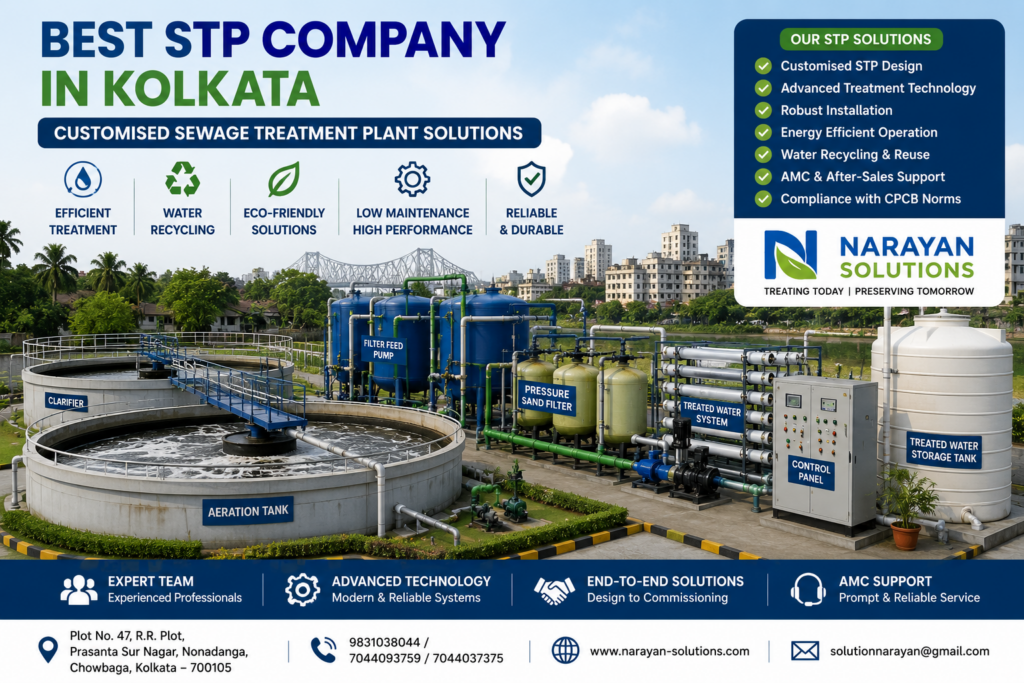
Best STP company in Kolkata providing customised sewage treatment plant solutions

Choosing the Best STP Company in Kolkata: Key Factors Every Project Owner Should Consider

With growing residential, commercial, hospitality and institutional developments, effective sewage management has become an important part of modern infrastructure. A properly designed Sewage Treatment Plant (STP) helps treat wastewater before appropriate discharge or reuse and can support responsible water management.

However, choosing the right STP provider is not simply about comparing equipment prices. The best STP company in Kolkata should understand your project’s wastewater generation, site conditions, treatment objectives, operational requirements and applicable environmental conditions.

CPCB’s STP performance evaluations have highlighted the importance of proper operation and maintenance, skilled manpower, flow measurement, disinfection, sludge management and reliable power arrangements.

Why Choosing the Right STP Company Matters

An STP is a long-term infrastructure investment. Poor system selection or inadequate design can lead to operational problems, higher maintenance requirements, unpleasant odour, inconsistent treatment performance and increased operating costs.

A professional STP manufacturer in Kolkata should therefore evaluate the complete project rather than recommend a standard plant without understanding the site’s requirements.

1. Check Technical Expertise

The first factor is technical capability.

An experienced STP company should be able to assess:

  • Daily sewage generation
  • Peak flow variations
  • Wastewater characteristics
  • Required treated-water quality
  • Available installation area
  • Hydraulic requirements
  • Sludge generation
  • Electricity and chemical requirements
  • Future expansion requirements

The treatment process should be selected according to the project’s actual wastewater profile rather than based only on plant capacity.

2. Look for Customised STP Design

Every project is different. A residential complex may have different wastewater characteristics and flow patterns compared with a hotel, hospital, school, factory or commercial building.

A reliable STP plant in Kolkata should therefore be designed around the project’s:

Capacity + Wastewater Characteristics + Space + Treatment Requirements + Reuse Objectives

Customised design can help improve system performance and make operation and maintenance more manageable.

3. Evaluate Treatment Technology

Different biological and tertiary treatment technologies may be suitable for different applications. Depending on project requirements, an STP may include preliminary treatment, biological treatment, clarification, filtration and disinfection.

The important question is not simply which technology is “best,” but which technology is appropriate for the specific project.

A professional STP provider should explain the proposed process, expected performance, operating requirements and limitations clearly before installation.

4. Consider Water Reuse Opportunities

Modern sewage treatment is increasingly connected with water conservation.

Depending on treated-water quality requirements and applicable conditions, treated sewage may be considered for suitable non-potable applications such as gardening, landscaping, toilet flushing or other utility uses.

CPCB documentation on STP performance also records examples of treated water being used for gardening and recommends appropriate disinfection before such reuse.

Therefore, when selecting an STP company in Kolkata, ask whether the proposed system can be integrated with your water-recycling objectives.

5. Check Installation and Commissioning Support

A quality STP depends on more than equipment. Proper installation, piping, electrical integration, instrumentation, testing and commissioning are important for reliable operation.

Your STP partner should provide clear support during:

  • Site assessment
  • Plant installation
  • Equipment integration
  • Testing and commissioning
  • Operator training
  • Performance monitoring

6. Ask About Operation & Maintenance

Long-term performance depends heavily on operation and maintenance.

CPCB’s STP evaluations have specifically identified skilled manpower, proper O&M, flow measurement, logbooks, sludge management and power backup as important operational considerations.

Before selecting a sewage treatment plant company, understand what is included in the AMC and after-sales service.

Ask about:

  • Preventive maintenance
  • Breakdown support
  • Operator assistance
  • Equipment inspection
  • Consumables
  • Periodic performance checks
  • Troubleshooting
  • AMC response time

7. Consider Energy Efficiency

Energy consumption can become a significant part of the lifetime cost of an STP.

A good design should consider efficient pumps, blowers, motors, controls and operating cycles. Automation can also help operators monitor and manage plant performance more effectively.

Instead of choosing a system solely on the lowest installation price, project owners should consider total lifecycle cost.

8. Verify Compliance Understanding

Environmental requirements can vary according to the project, location, discharge route and applicable permissions. CPCB is India’s statutory pollution-control body and maintains technical guidance, environmental rules and monitoring information relating to pollution control.

A professional STP company should help the project team understand the applicable treatment and monitoring requirements and design the system accordingly.

Why Choose Narayan Solutions?

Narayan Solutions provides customised water and wastewater treatment solutions for different project requirements.

For customers looking for an STP company in Kolkata, Narayan Solutions focuses on sewage-treatment solutions, wastewater recovery, customised systems, installation support and AMC services.

The right STP partner should provide more than a treatment unit—it should provide a complete solution covering design, installation, commissioning, operation and long-term support.

Final Checklist Before Choosing an STP Company

Before finalising your supplier, compare:

✅ Technical expertise
✅ Customised plant design
✅ Appropriate treatment technology
✅ Quality of equipment
✅ Installation and commissioning support
✅ Water-reuse possibilities
✅ Energy efficiency
✅ Automation and monitoring
✅ AMC and after-sales support
✅ Operator training
✅ Compliance understanding
✅ Total lifecycle cost

Conclusion

Choosing the best STP company in Kolkata requires careful evaluation of technology, design expertise, installation capabilities, operating costs and long-term support.

The cheapest quotation may not always provide the best value. A properly designed and professionally maintained STP can offer better reliability, treatment performance and long-term operational efficiency.

If you are planning an STP for a residential project, hotel, hospital, institution, commercial property or industrial facility, consult a qualified wastewater-treatment provider and assess the project requirements before making a decision.

Contact Us

📍 Address: Plot No. 47, R.R. Plot, Prasanta Sur Nagar, Nonadanga, Chowbaga, Kolkata – 700105

📞 Call: 9831038044 / 7044093759 / 7044037375

🌐 Website: https://narayan-solutions.com

📩 Email: solutionnarayan@gmail.com

STP Company Kolkata | Sewage Treatment Plant Kolkata | STP Manufacturer Kolkata | STP Plant in Kolkata | Sewage Treatment Plant Manufacturer | Wastewater Treatment Company Kolkata | STP Installation Kolkata | STP AMC Services

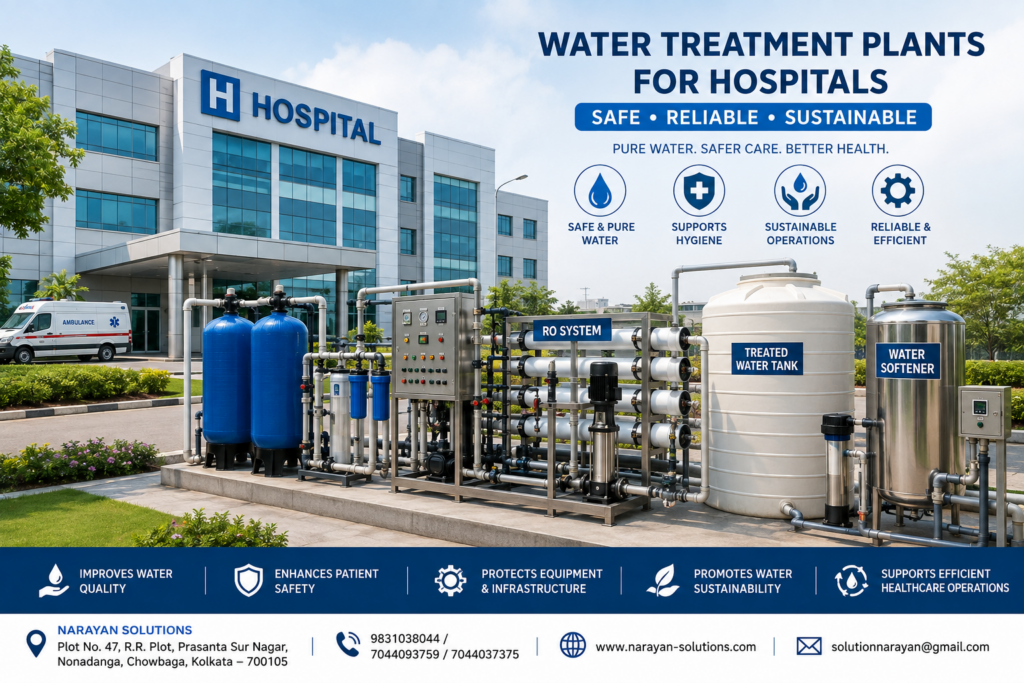
Water treatment plant for hospitals providing safe and reliable water supply

Water Treatment Plants for Hospitals: Ensuring Safe, Reliable and Sustainable Water Supply

Hospitals require a dependable supply of appropriately treated water for patient care, hygiene, cleaning, kitchens, laundry, laboratories, cooling systems and other essential operations. Because water quality can directly affect healthcare environments, hospitals need a carefully planned approach to water treatment and water management.

The World Health Organization identifies water, sanitation and hygiene (WASH) services as essential components of safe, quality healthcare and infection prevention.

A properly designed water treatment plant for hospitals can help improve incoming water quality and provide treated water suitable for specific applications.

Why Hospitals Need Water Treatment Plants

Hospital water sources may contain suspended particles, hardness, dissolved minerals, organic contaminants or microorganisms depending on the source and local conditions. A treatment system helps address the specific characteristics of the incoming water.

The treatment process should be based on water-quality testing, intended use, required water quality and applicable standards. In India, IS 10500 provides specifications for drinking water quality, including physical, chemical and microbiological parameters.

For healthcare facilities, water treatment should therefore be considered as part of a broader water-safety and facility-management strategy rather than simply as an equipment purchase.

Common Components of a Hospital WTP

The exact configuration depends on source-water quality and application, but a hospital Water Treatment Plant (WTP) may include:

  • Raw Water Storage: Provides a controlled supply for treatment.
  • Pressure Sand Filter: Helps reduce suspended particles and turbidity.
  • Activated Carbon Filter: Helps reduce certain organic compounds, odour and colour.
  • Water Softener: Reduces hardness where required.
  • Micron Filtration: Provides additional particulate filtration.
  • Ultrafiltration: Can provide membrane-based removal of fine particles and microorganisms, depending on the system.
  • Reverse Osmosis (RO): Reduces dissolved salts and other contaminants when required.
  • UV or Disinfection: Provides an additional microbial-control step where appropriate.
  • Treated Water Storage: Maintains treated-water availability for designated applications.
  • Pumping and Control Systems: Support reliable distribution and system operation.

Not every hospital requires all these stages. A customised design is generally more effective because treatment requirements vary according to the source and end use.

Applications of Water Treatment in Hospitals

A well-planned hospital WTP can support different areas of healthcare operations, including:

Drinking and Food Preparation

Where water is intended for drinking or food preparation, treatment should be designed to meet the applicable drinking-water requirements.

Patient Care and Hygiene

Reliable water quality is essential for hand hygiene, cleaning and routine hospital operations. WHO states that functioning WASH services are crucial for quality care and infection prevention.

Laundry and Housekeeping

Hospitals can consume significant quantities of water for laundry and cleaning. Appropriate treatment can help manage source-water issues that may affect these operations.

Laboratories and Specialised Applications

Some laboratories and specialised equipment may require water of specific quality. Additional purification stages may be necessary depending on the application and equipment manufacturer’s requirements.

Cooling and Utility Systems

Treated water may also be required for selected utility applications such as cooling systems, subject to the required water-quality specifications.

Benefits of a Hospital Water Treatment Plant

1. Improved Water Quality

A properly selected treatment process can address specific physical, chemical and microbiological water-quality concerns.

2. Reliable Water Supply

Hospitals operate continuously, making reliable water availability an important operational requirement.

3. Better Hygiene Management

Safe and reliable water supports cleaning, hand hygiene and other essential healthcare-facility activities. WHO considers WASH services fundamental to quality healthcare.

4. Equipment Protection

Treating hard or mineral-rich water can help reduce scaling and protect certain plumbing, heating and utility equipment.

5. Sustainable Water Management

Water treatment can be combined with wastewater treatment and reuse strategies to reduce unnecessary freshwater consumption where technically appropriate.

How to Select the Right WTP for a Hospital

Before selecting a hospital water treatment plant, consider:

  • Source of raw water
  • Daily and peak water demand
  • Raw-water laboratory analysis
  • Required treated-water quality
  • Drinking-water requirements
  • Hospital size and occupancy
  • Specialised medical applications
  • Available installation space
  • Energy and chemical consumption
  • Automation and monitoring
  • Maintenance requirements
  • Future capacity expansion

A professional water-treatment assessment helps determine the appropriate treatment stages, capacity and operating requirements.

Sustainable Hospital Water Management

Modern hospitals can go beyond water purification by developing an integrated water-management strategy. This can include WTP, STP, wastewater recycling, rainwater management and efficient water-use practices.

Treated wastewater, where appropriate and permitted, may be considered for suitable non-potable applications. This approach can help hospitals reduce freshwater demand while improving overall resource efficiency.

WHO’s recent guidance on healthcare-facility WASH also emphasizes sustainable and climate-resilient infrastructure and informed selection of water and sanitation technologies.

Why Choose Narayan Solutions?

Narayan Solutions provides customised water and wastewater treatment solutions based on project requirements.

For hospitals seeking a Water Treatment Plant in Kolkata, the right solution can be developed around source-water quality, required capacity, intended applications, available space and long-term operational needs.

From treatment-system planning and installation support to operation and AMC requirements, a reliable treatment partner can help hospitals maintain a dependable water-management system.

Conclusion

A Water Treatment Plant for hospitals is an important part of reliable healthcare infrastructure. From drinking water and hygiene to specialised applications and utility operations, different hospital departments may require different levels of water quality.

By combining appropriate treatment technology, regular water-quality monitoring, efficient operation and sustainable water-management practices, hospitals can build a safer and more reliable water system.

If you are planning a hospital WTP in Kolkata or elsewhere in India, consult a professional treatment-system provider to assess your water source and application requirements.

Contact Us

📍 Address: Plot No. 47, R.R. Plot, Prasanta Sur Nagar, Nonadanga, Chowbaga, Kolkata – 700105

📞 Call: 9831038044 / 7044093759 / 7044037375

🌐 Website: Narayan Solutions

📩 Email: solutionnarayan@gmail.com

Hospital Water Treatment Plant | WTP for Hospitals | Water Treatment Plant Kolkata | Hospital WTP Solutions | Hospital Water Purification | RO Plant for Hospitals | Industrial WTP | Sustainable Water Management

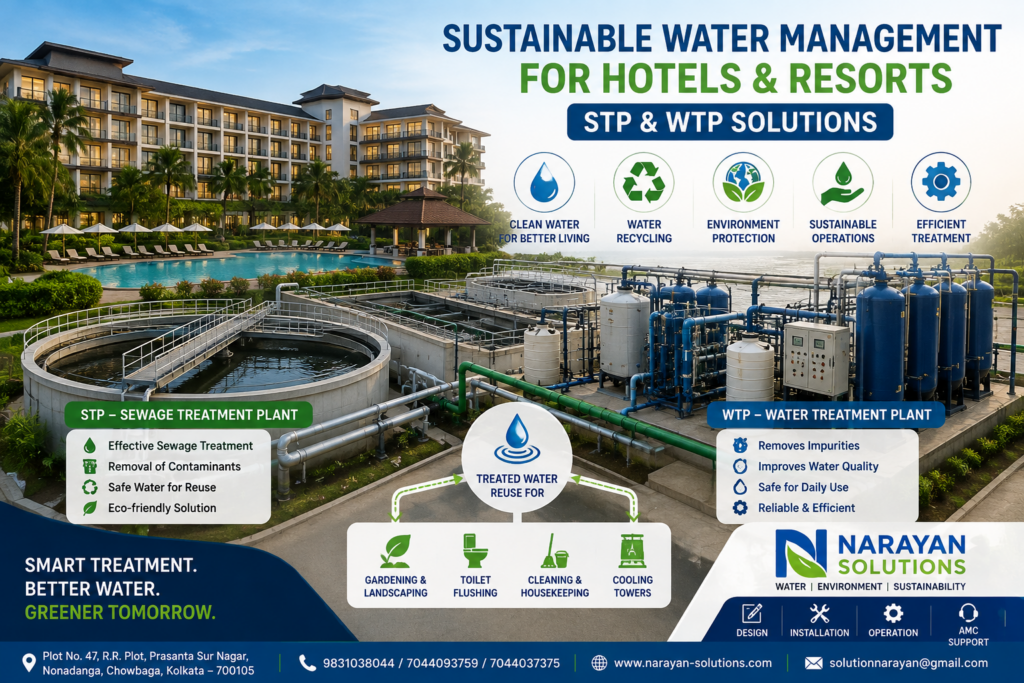
Sustainable water management for hotels and resorts using STP and WTP solutions

Sustainable Water Management for Hotels and Resorts: STP & WTP Solutions Explained

Hotels and resorts depend heavily on water for guest rooms, restaurants, kitchens, laundry, housekeeping, landscaping, swimming pools and other daily operations. With increasing pressure on freshwater resources, effective sustainable water management for hotels and resorts has become an important part of responsible hospitality.

A combination of a properly designed Sewage Treatment Plant (STP) and Water Treatment Plant (WTP) can help hospitality businesses treat wastewater, improve water quality and explore opportunities for water reuse.

The Central Pollution Control Board (CPCB) has also highlighted the importance of treating sewage and maximizing reuse of treated water for non-potable purposes such as toilet flushing, floor washing and gardening in applicable hotel-related requirements.

Why Hotels and Resorts Need STP Solutions

Hotels generate sewage from toilets, bathrooms, kitchens, laundry and other facilities. The wastewater can contain organic matter, suspended solids, detergents, oils, nutrients and microorganisms.

A Sewage Treatment Plant for hotels is designed to treat this wastewater before appropriate discharge or reuse. The treatment process can include preliminary treatment, biological treatment, clarification, filtration and disinfection, depending on the wastewater characteristics and required treated-water quality.

For larger properties, a properly sized STP can help manage changing occupancy levels and seasonal variations in wastewater generation.

What Is a WTP for Hotels and Resorts?

A Water Treatment Plant (WTP) is used to improve the quality of incoming water for specific applications. Depending on the source-water characteristics and end-use requirements, a WTP may incorporate processes such as filtration, softening, activated carbon treatment, ultrafiltration or reverse osmosis.

The exact configuration should be determined through water-quality testing and an assessment of the property’s requirements.

A well-planned WTP solution for hotels and resorts can support applications such as drinking-water treatment, kitchen operations, laundry and other uses where treated water quality is required.

STP + WTP: Creating a Sustainable Water Cycle

Using STP and WTP systems together can help hotels move toward a more efficient water-management model:

Freshwater Source → WTP → Hotel Operations → Wastewater → STP → Treated Water → Suitable Non-Potable Reuse

Depending on quality requirements and applicable permissions, treated wastewater can potentially be reused for landscaping, toilet flushing, cleaning and other non-potable applications.

CPCB’s wastewater-reuse guidance promotes treating wastewater as a resource and using treated sewage for suitable non-potable applications as part of a circular approach to water management.

Key Benefits of Hotel & Resort STP/WTP Solutions

1. Reduced Freshwater Dependency

Reusing appropriately treated wastewater can reduce the demand for fresh water for selected applications.

2. Responsible Wastewater Management

An STP provides a structured approach to treating sewage generated by daily hotel operations.

3. Better Water Quality

WTP systems can help improve incoming water quality according to the requirements of different hotel facilities.

4. Support for Environmental Compliance

Hotels and resorts must consider applicable environmental requirements, consent conditions and discharge/reuse requirements. CPCB identifies water-pollution prevention and control as an important part of its statutory functions.

5. Sustainable Hospitality

Water recycling and efficient treatment can support the environmental goals of hotels and resorts while contributing to long-term resource conservation.

How to Choose the Right STP and WTP

Before installing a treatment system, hotels should evaluate:

  • Daily water consumption
  • Average and peak sewage generation
  • Guest occupancy and seasonal variations
  • Incoming water quality
  • Required treated-water quality
  • Available installation space
  • Potential water-reuse applications
  • Energy and chemical requirements
  • Automation and monitoring needs
  • Operation and maintenance requirements
  • Future expansion plans

A customised design is generally preferable to a standard system because every hotel and resort has different water demand, wastewater characteristics and site conditions.

Why Choose Narayan Solutions?

Narayan Solutions provides wastewater and water-treatment solutions designed around specific project requirements.

For hotels, resorts and commercial properties looking for STP and WTP solutions in Kolkata, a customised approach can help integrate wastewater treatment, water purification, recovery and reuse into an efficient water-management strategy.

From system selection and installation support to ongoing AMC requirements, the right treatment partner can help make water management more reliable and sustainable.

Conclusion

Sustainable water management for hotels and resorts is more than simply treating wastewater. It involves understanding water consumption, improving water quality, treating sewage effectively and identifying practical opportunities for reuse.

With appropriately designed STP and WTP solutions, hospitality businesses can work toward better wastewater management, water conservation and sustainable operations.

Contact Us

📍 Address: Plot No. 47, R.R. Plot, Prasanta Sur Nagar, Nonadanga, Chowbaga, Kolkata – 700105

📞 Call: 9831038044 / 7044093759 / 7044037375

🌐 Website: https://narayan-solutions.com

📩 Email: solutionnarayan@gmail.com

Hotel STP Plant | Resort STP Plant | Sewage Treatment Plant for Hotels | Water Treatment Plant for Hotels | WTP Solutions | Wastewater Recycling | Hotel Wastewater Treatment | STP Plant Kolkata | WTP Plant Kolkata

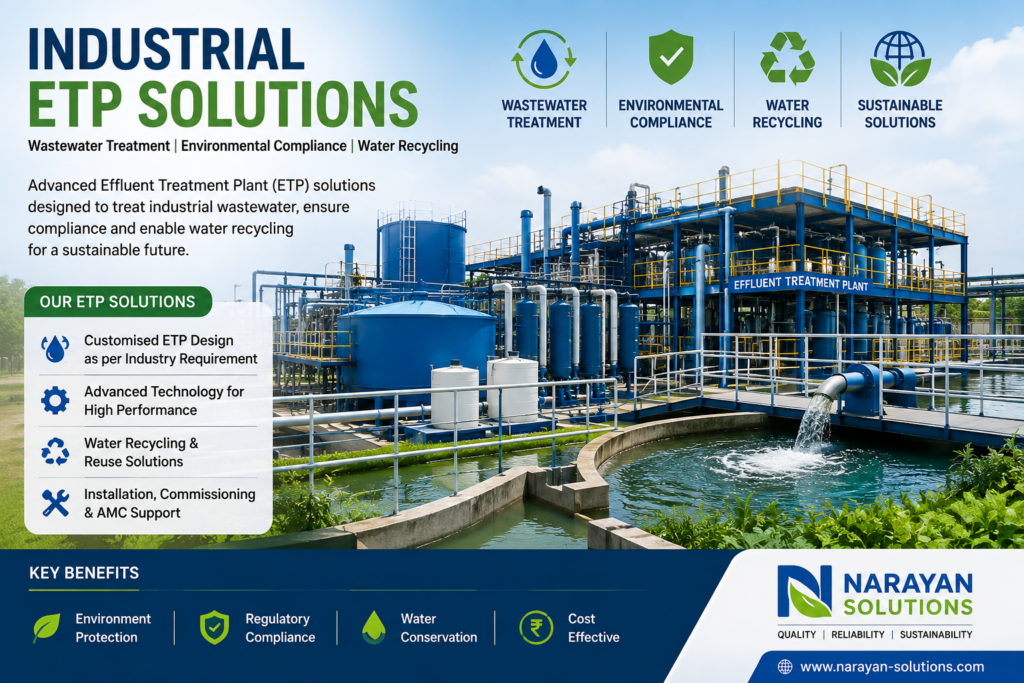
Industrial ETP solutions for wastewater treatment and water recycling in Kolkata

Industrial ETP Solutions: A Complete Guide to Environmental Compliance and Water Recycling

Industrial growth generates employment and economic value, but it can also produce wastewater containing organic matter, suspended solids, oils, chemicals, nutrients and other pollutants. Without appropriate treatment, industrial effluent can create environmental risks and make responsible water management more difficult.

This is where industrial ETP solutions become essential. An Effluent Treatment Plant (ETP) is designed to treat wastewater generated by industrial processes so that the treated effluent can be managed, discharged or reused according to applicable requirements and intended end use.

For industries in Kolkata and across eastern India, choosing a properly designed ETP is an important step toward sustainable wastewater management.

What Is an Industrial ETP?

An Effluent Treatment Plant (ETP) is a wastewater treatment system designed specifically for industrial effluent. Unlike domestic sewage, industrial wastewater can vary significantly according to the manufacturing process, raw materials, chemicals used and production volume.

A well-designed ETP may combine physical, chemical and biological treatment processes. Typical stages can include screening, collection and equalisation, oil and grease removal, coagulation-flocculation, clarification, biological treatment and tertiary filtration.

CPCB technical material describes ETP treatment schemes involving primary, secondary and tertiary treatment stages, with treatment processes selected according to wastewater characteristics and the required treated-water quality.

Why Industrial ETP Solutions Are Important

1. Environmental Protection

Proper treatment reduces pollutants before wastewater is discharged or reused. This helps protect surrounding water resources and supports responsible industrial operations.

2. Environmental Compliance

Industries must manage effluent according to applicable environmental requirements and consent conditions. CPCB maintains industry-specific effluent standards covering sectors such as chemicals, pharmaceuticals, dyes, paints, petrochemicals and other industries.

Because requirements can differ by industry and discharge route, an ETP should be designed around the actual wastewater characteristics and applicable standards rather than using a one-size-fits-all approach.

3. Water Recycling and Reuse

Modern ETP design increasingly focuses not only on treatment but also on water recovery and recycling. Depending on the treated-water quality required, tertiary treatment and advanced processes can make treated wastewater suitable for selected non-potable applications.

CPCB guidance also encourages reuse and recycling of treated effluent where feasible.

4. Better Resource Management

Water recycling can reduce dependence on fresh-water sources and help industries use water more efficiently. For suitable applications, recovered water may support activities such as cooling, washing, gardening or other process-related uses, subject to quality requirements.

Major Components of an Industrial ETP

The treatment configuration depends on the industry and wastewater profile, but an ETP may include:

  • Collection and Equalisation Tank – balances variations in flow and pollutant concentration.
  • Screening System – removes larger floating and solid materials.
  • Oil & Grease Removal – separates oils and floating contaminants where required.
  • Chemical Treatment – coagulation and flocculation can help remove suspended and colloidal particles.
  • Primary Clarification – separates settleable solids from wastewater.
  • Biological Treatment – reduces biodegradable organic pollutants where applicable.
  • Secondary Clarification – separates biological solids from treated water.
  • Tertiary Treatment – filtration or advanced treatment can improve final water quality.
  • Sludge Management – handles sludge generated during treatment.
  • Water Recycling System – enables recovery and reuse where technically and economically feasible.

CPCB documentation identifies proper operation and maintenance, suitable technology selection and effective effluent management as important factors in industrial wastewater treatment.

How to Choose the Right ETP Solution

Selecting an ETP should begin with a detailed assessment of the wastewater. Important considerations include:

Wastewater quantity: Average and peak flow rates determine plant capacity.

Wastewater characteristics: Parameters such as pH, BOD, COD, TSS, oil and grease, nutrients and industry-specific contaminants influence treatment selection.

Required treated-water quality: Discharge and reuse requirements determine the level of treatment necessary.

Space and operating conditions: Plant footprint, automation, energy consumption and operator requirements should be considered during design.

Future expansion: A scalable solution can help accommodate changes in production capacity.

Why Choose Narayan Solutions?

Narayan Solutions provides wastewater treatment solutions designed around industrial requirements. Its services include ETP solutions, wastewater recovery, customised treatment systems, installation support and AMC services.

For industries seeking an ETP plant in Kolkata, a customised approach can help align treatment performance, operational requirements, water-recovery objectives and site conditions.

The right ETP is not simply a wastewater-treatment machine—it is an important part of a company’s long-term environmental and water-management strategy.

Conclusion

Effective industrial ETP solutions can help businesses manage wastewater responsibly while supporting environmental protection, regulatory compliance and water conservation. With appropriate process selection, regular monitoring and proper operation and maintenance, an ETP can become an important investment in sustainable industrial development.

For customised Effluent Treatment Plant and industrial wastewater treatment solutions in Kolkata, contact Narayan Solutions to discuss your wastewater-treatment requirements.

Need a customised industrial ETP solution? Contact Narayan Solutions today for wastewater treatment, water recovery, installation and AMC support.

Contact Us

📍 Address: Plot No. 47, R.R. Plot, Prasanta Sur Nagar, Nonadanga, Chowbaga, Kolkata – 700105

📞 Call: 9831038044 / 7044093759 / 7044037375

🌐 Website: https://narayan-solutions.com

📩 Email: solutionnarayan@gmail.com


Effluent Treatment Plant | Industrial Wastewater Treatment | ETP Plant in Kolkata | Industrial ETP Plant | Wastewater Recycling | Effluent Treatment Plant Kolkata | Water Recycling Solutions | ETP Manufacturer Kolkata

Industrial wastewater treatment plant and ETP solutions in Kolkata

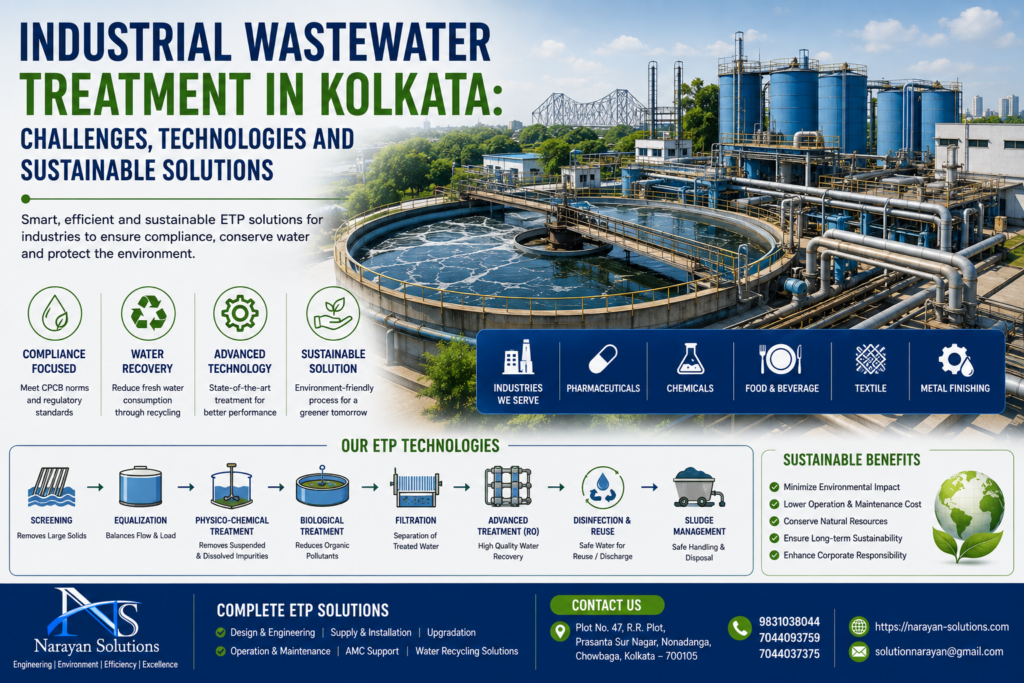
Industrial Wastewater Treatment in Kolkata: Challenges, Technologies and Sustainable Solutions

Kolkata is a major commercial and industrial centre in eastern India. Industries such as pharmaceuticals, chemicals, textiles, food processing and engineering generate wastewater during their daily operations.

This wastewater may contain organic matter, suspended solids, oils, chemicals, nutrients and other pollutants. Therefore, effective industrial wastewater treatment in Kolkata is essential for responsible water management and environmental protection.

A properly designed Effluent Treatment Plant (ETP) can help industries treat wastewater, recover water where practical and manage treated effluent responsibly.

What Is Industrial Wastewater Treatment?

Industrial wastewater treatment removes physical, chemical and biological pollutants from wastewater generated by industrial processes.

An ETP plant is designed according to the wastewater quality, flow rate and treatment objectives of each industry.

Depending on the application, an ETP may include:

  • Screening and preliminary treatment
  • Equalization
  • Oil and grease removal
  • Physico-chemical treatment
  • Biological treatment
  • Filtration
  • Membrane treatment
  • Disinfection
  • Sludge management
  • Water recovery and reuse

There is no single treatment method for every industry. Wastewater testing and process evaluation are important for selecting the right treatment technology.

Major Challenges of Industrial Wastewater Treatment in Kolkata

1. Different Wastewater Characteristics

Every industry produces wastewater with different characteristics.

For example, pharmaceutical and chemical industries may generate wastewater containing complex pollutants. Food-processing industries may produce wastewater with higher organic loads.

Therefore, ETP systems should be designed according to the actual wastewater characteristics.

2. Changing Flow and Pollutant Loads

Industrial production may change during different shifts, seasons or production cycles.

As a result, wastewater flow and parameters such as pH, COD, BOD and TSS can fluctuate.

An equalization system and suitable process controls can help manage these variations more effectively.

3. Limited Space

Many industrial facilities have limited space for new treatment infrastructure or plant expansion.

Compact treatment technologies, efficient equipment layouts and suitable system design can help make better use of the available area.

4. Sludge Management

Wastewater treatment generates sludge that requires proper handling.

Sludge thickening, dewatering, storage and disposal should therefore be included in the overall industrial wastewater management plan.

5. Energy and Operating Costs

Pumps, blowers, mixers, dosing systems and advanced treatment equipment require energy and regular maintenance.

Energy-efficient equipment, automation, preventive maintenance and process optimization can help improve operational efficiency.

Technologies Used in Industrial Wastewater Treatment

Physico-Chemical Treatment

Processes such as coagulation, flocculation and clarification can help remove suspended solids and selected contaminants.

Depending on the wastewater, these processes may be used as pretreatment or primary treatment.

Biological Treatment

Biological treatment uses microorganisms to break down biodegradable organic pollutants.

The appropriate biological process depends on wastewater characteristics, treatment objectives and plant capacity.

Membrane Technology

Advanced membrane technologies such as Ultrafiltration (UF), Nanofiltration (NF) and Reverse Osmosis (RO) can provide higher levels of treatment and support water recovery.

These technologies are particularly useful when treated water is intended for suitable reuse applications.

Advanced Water Recovery

Industries looking to increase water reuse can combine ETP treatment with filtration, RO and other advanced technologies.

For suitable applications, Zero Liquid Discharge (ZLD) may also be considered to maximize water recovery and manage concentrated waste streams.

Sustainable Solutions for Industrial Wastewater

Modern wastewater management is gradually moving from a simple “treat and discharge” approach toward a more sustainable “treat, recover and reuse” model.

Industries can consider:

  • Water recycling
  • Treated-water reuse
  • Process-water recovery
  • Energy-efficient equipment
  • Automated monitoring
  • Preventive maintenance
  • ETP upgrades
  • Advanced filtration
  • Membrane treatment
  • Improved sludge management

Water recycling can reduce freshwater demand and improve overall resource efficiency.

Role of Automation in ETP Plants

Automation can make modern ETP solutions in Kolkata easier to monitor and manage.

Technologies such as sensors, PLCs, SCADA systems and automated dosing equipment can help operators:

  • Monitor important process parameters
  • Control pumps and other equipment
  • Manage chemical dosing
  • Detect abnormal operating conditions
  • Track plant performance
  • Improve operational consistency

The level of automation should be selected according to the plant’s technology, capacity and operational requirements.

Why Choose Narayan Solutions?

Narayan Solutions provides customized industrial wastewater treatment and ETP solutions for different industrial applications.

Services may include:

  • ETP design and engineering
  • Installation and commissioning
  • Plant upgrading and retrofitting
  • Advanced wastewater treatment
  • Water recovery solutions
  • Operation and maintenance
  • AMC support
  • Customized wastewater treatment solutions

The right ETP begins with a clear understanding of the wastewater. A detailed assessment of flow rate, pollutant characteristics, treatment objectives, available space and operational requirements can help determine the most suitable treatment approach.

For customized industrial wastewater treatment solutions in Kolkata and beyond, visit Narayan Solutions.

Conclusion

Industrial wastewater treatment in Kolkata plays an important role in sustainable industrial development.

As industries focus on water conservation, environmental responsibility and efficient operations, modern ETP technologies can provide practical solutions for wastewater management.

From physico-chemical and biological treatment to membrane filtration, automation and water recovery, the right combination of technologies can improve treatment performance and support responsible water use.

A properly designed and maintained ETP can also create opportunities for water recycling, reuse and resource conservation.

Looking for Industrial Wastewater Treatment Solutions?

Contact Narayan Solutions for customized ETP design, installation, upgrading, operation, maintenance and water-recovery solutions.


Contact Us

📍 Address: Plot No. 47, R.R. Plot, Prasanta Sur Nagar, Nonadanga, Chowbaga, Kolkata – 700105

📞 Call: 9831038044 / 7044093759 / 7044037375

🌐 Website: https://narayan-solutions.com/

📩 Email: solutionnarayan@gmail.com


Frequently Asked Questions

1. What is industrial wastewater treatment?

Industrial wastewater treatment removes pollutants from wastewater generated by industrial processes. The treated water may then be suitable for permitted discharge, reuse or further treatment, depending on its quality and applicable requirements.

2. What is an ETP plant?

An Effluent Treatment Plant (ETP) is a treatment system designed to manage wastewater generated by industrial activities.

3. Which industries may require ETP solutions?

Industries such as chemicals, pharmaceuticals, textiles, food processing, engineering and manufacturing may require wastewater treatment depending on their processes and applicable requirements.

4. Can treated industrial wastewater be reused?

Yes. Treated wastewater can potentially be reused when its quality is suitable for the intended application. The reuse system should be designed according to process requirements and applicable standards.

5. Can an existing ETP be upgraded?

Yes. Depending on its existing design and condition, an ETP may be upgraded with additional treatment stages, automation, filtration, membrane systems or other suitable technologies.


industrial wastewater treatment | ETP plant Kolkata | effluent treatment plant | wastewater recycling | industrial water treatment | ETP solutions in Kolkata | sustainable wastewater management | industrial wastewater treatment plant | water recovery system | ETP operation and maintenance

Smart automation system for water and wastewater treatment plant with SCADA monitoring

How Smart Automation Is Improving Modern Water and Wastewater Treatment Plants

Water and wastewater treatment plants are becoming smarter, faster and more efficient. Industries and facilities are adopting automation to improve reliability, reduce manual work and manage resources effectively.

Traditional treatment plants often depend on manual monitoring and operator intervention. Today, smart automation in water and wastewater treatment is changing this approach.

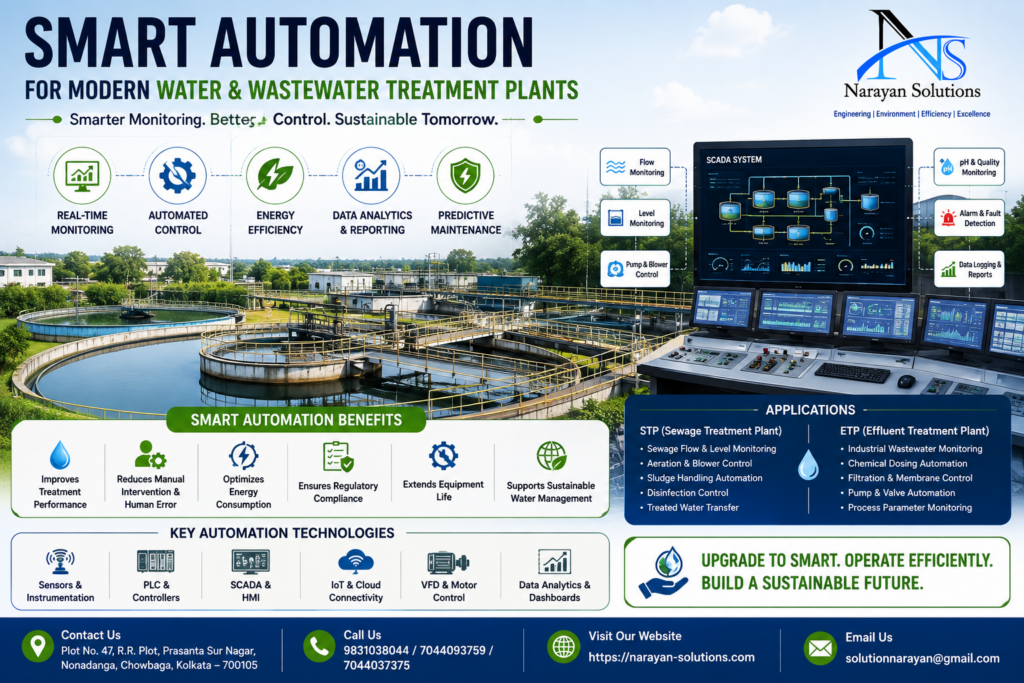
Sensors, PLCs, SCADA systems, data dashboards and automated controls provide real-time information. As a result, operators can monitor plant conditions, control equipment and respond quickly to process changes.

What Is Smart Automation in Water Treatment?

Smart water treatment combines sensors, control systems and software to monitor and manage treatment processes automatically.

A modern automated treatment plant may use:

  • Online sensors
  • Flow meters
  • Level sensors
  • pH and turbidity monitoring
  • PLC-based controls
  • SCADA systems
  • Human-machine interfaces (HMI)
  • Variable frequency drives (VFDs)
  • Automated dosing systems
  • Data logging and dashboards

Together, these technologies improve plant visibility and simplify routine operations.

How Automation Improves Treatment Plant Performance

1. Real-Time Monitoring

Real-time monitoring is one of the biggest benefits of wastewater treatment automation.

Sensors continuously collect information about flow, tank levels and water-quality parameters. Operators can view this information through SCADA and monitoring platforms.

This makes it easier to identify changes quickly and take corrective action when required.

2. Better Process Control

Automated systems can control pumps, valves, blowers and other equipment according to programmed conditions.

For example, the system can respond to changes in tank levels or process requirements. This reduces unnecessary manual intervention and supports more consistent plant operation.

3. Improved Energy Efficiency

Pumps, blowers and aeration systems can consume considerable energy.

Water treatment plant automation can help optimize equipment operation according to actual process requirements. VFDs can also help control motor speed where appropriate.

Better control can support efficient energy use while maintaining required treatment performance.

4. Automated Chemical Dosing

Many treatment processes require controlled chemical dosing.

An automated dosing system can use process measurements and programmed set points to regulate chemical addition. This can improve dosing consistency and help avoid unnecessary chemical consumption.

The correct control method depends on the treatment process, wastewater characteristics and required water quality.

5. Faster Fault Detection

Smart monitoring can identify abnormal conditions such as:

  • Pump failures
  • High tank levels
  • Equipment faults
  • Unusual operating conditions
  • Changes in process parameters

Early warnings allow operators to investigate problems before they become major failures.

This can support preventive maintenance and reduce unexpected downtime.

6. Better Data and Performance Analysis

Modern automation systems can record plant data continuously.

Historical information helps operators identify trends, compare performance and monitor equipment condition.

This data can also support better maintenance planning and process optimization.

Smart Automation for STP and ETP Plants

Automation can be used in both smart STP and smart ETP systems.

For Sewage Treatment Plants (STPs), automation can help monitor and control:

  • Sewage flow
  • Tank levels
  • Aeration
  • Pump operation
  • Sludge handling
  • Disinfection
  • Treated-water transfer

For Effluent Treatment Plants (ETPs), automation can support:

  • Industrial wastewater monitoring
  • Chemical dosing
  • Filtration
  • Membrane treatment
  • Pump and valve control
  • Process parameter monitoring

The right level of automation depends on plant capacity, treatment technology, wastewater characteristics and operational requirements.

Smart Automation and Predictive Maintenance

Automation can make maintenance more proactive.

By monitoring equipment status and operating conditions, plant teams can identify unusual patterns early. These warning signs may indicate developing equipment problems.

Instead of waiting for a breakdown, operators can schedule inspections and maintenance at the right time.

This approach can improve equipment reliability and help reduce avoidable downtime.

Why IoT Matters in Wastewater Treatment

IoT wastewater treatment systems can connect sensors, equipment and monitoring platforms to improve data collection and plant visibility.

With suitable infrastructure, operators can access important operational information from centralized dashboards. This can make it easier to monitor performance and respond to changing conditions.

IoT-based monitoring can be particularly useful for facilities that require continuous supervision and detailed operational records.

Why Cybersecurity Matters

As treatment plants become more connected, cybersecurity becomes increasingly important.

SCADA systems, PLCs, networks and remote-access platforms should be protected with suitable security measures.

Facilities should consider secure access, network protection, backups, software updates and appropriate user permissions when implementing automated systems.

Why Choose Narayan Solutions?

Narayan Solutions provides customized water and wastewater treatment solutions for industrial, commercial and institutional requirements.

Automation can be integrated into new treatment plants or included as part of suitable STP and ETP upgrades.

Depending on project requirements, solutions may include:

  • Process monitoring
  • Automated controls
  • Equipment integration
  • Plant upgrading
  • STP and ETP solutions
  • Operation and maintenance support

Every automation system should be designed around the actual treatment process and operational requirements of the facility.

Conclusion

Smart automation in water and wastewater treatment is helping modern facilities achieve more reliable and data-driven operations.

From real-time monitoring and automated control to energy optimization, fault detection and predictive maintenance, automation offers several opportunities to improve plant management.

As industries focus more on water conservation and operational efficiency, industrial wastewater management is becoming increasingly technology-driven.

The right combination of automation, monitoring and treatment technology can help facilities build smarter, more efficient and sustainable water infrastructure.

Looking for Smart Water & Wastewater Treatment Solutions?

Contact Narayan Solutions for customized STP, ETP, WTP, automation, upgrading, operation and maintenance solutions.

Contact Us

📍 Address: Plot No. 47, R.R. Plot, Prasanta Sur Nagar, Nonadanga, Chowbaga, Kolkata – 700105

📞 Call: 9831038044 / 7044093759 / 7044037375

🌐 Website: https://narayan-solutions.com

📩 Email: solutionnarayan@gmail.com


Frequently Asked Questions

1. What is smart automation in wastewater treatment?

Smart automation uses sensors, PLCs, SCADA, software and automated equipment controls to monitor and manage wastewater treatment processes.

2. What is SCADA in water treatment?

SCADA is a monitoring and control system that collects operational data and helps operators supervise connected treatment equipment.

3. Can automation improve STP performance?

Yes. Suitable automation can support real-time monitoring, process control, equipment management, fault detection and consistent operation.

4. Can existing STPs and ETPs be automated?

In many cases, existing plants can be upgraded with suitable sensors, PLCs, control panels, VFDs and SCADA systems. Feasibility depends on the existing plant design and equipment.

5. Can automation improve energy efficiency?

Automation can help optimize equipment operation and energy use. Actual results depend on the existing system, equipment efficiency, process conditions and control strategy.


smart water treatment | wastewater treatment automation | SCADA water treatment | automated wastewater treatment plant | smart STP | smart ETP | water treatment plant automation | IoT wastewater treatment | industrial wastewater management | wastewater monitoring system

STP AMC services for regular sewage treatment plant operation and maintenance

STP AMC Services: Why Regular Operation and Maintenance Matters for Long-Term Performance

A sewage treatment plant (STP) is an important part of modern residential, commercial, institutional and industrial infrastructure. However, installing an STP is only the first step. Regular operation, inspection and maintenance are essential to keep the plant performing efficiently over the long term.

STP AMC Services (Annual Maintenance Contract) provide a structured approach to maintaining sewage treatment systems. Regular monitoring and preventive maintenance can help identify developing problems before they become major breakdowns.

For businesses and property owners, professional STP operation and maintenance can support consistent treatment performance, equipment reliability and better wastewater management.

What Are STP AMC Services?

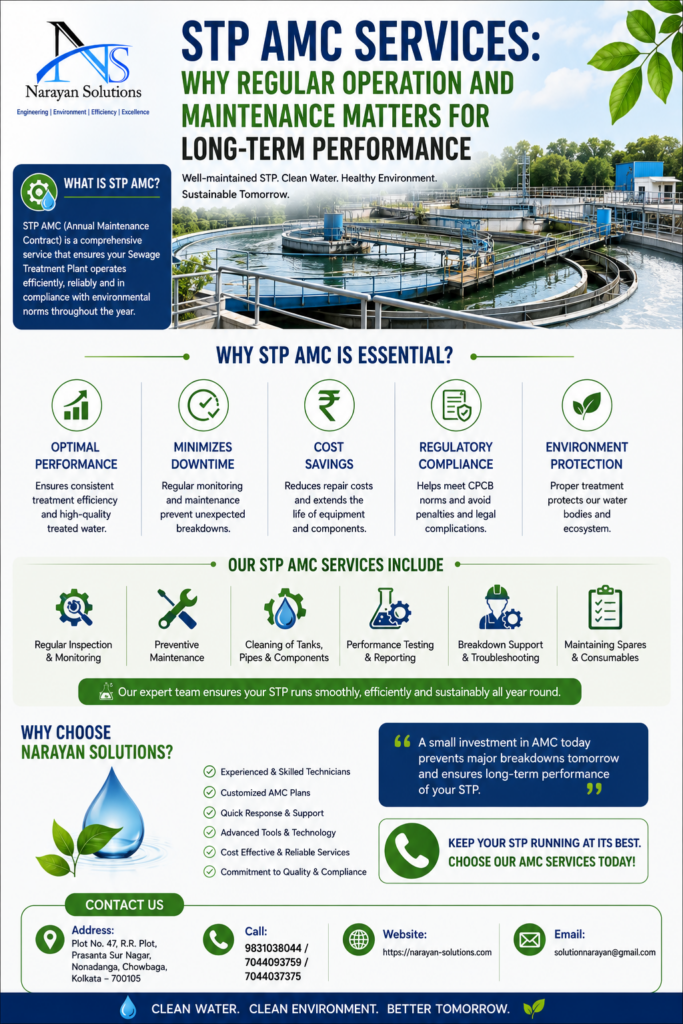
An STP AMC is a service agreement designed to provide regular operation, inspection, preventive maintenance and technical support for a sewage treatment plant.

Depending on the plant configuration and service requirements, an AMC may include:

  • Regular plant inspection and monitoring
  • Preventive maintenance
  • Pump and blower inspection
  • Tank and pipeline cleaning
  • Electrical and mechanical checks
  • Performance monitoring
  • Troubleshooting and breakdown support
  • Replacement guidance for worn components
  • Operational assistance
  • Maintenance reporting

The exact scope of an AMC should be customized according to the STP’s technology, capacity, equipment and operating conditions.

Why Regular STP Maintenance Matters

1. Maintains Treatment Efficiency

An STP must operate within appropriate process conditions to achieve consistent treatment performance.

Regular monitoring helps identify issues involving aeration, pumps, blowers, sludge handling and other critical components. Timely corrective action can help maintain stable plant operation.

2. Reduces Unexpected Breakdowns

Equipment failures can interrupt sewage treatment and create operational challenges.

Preventive maintenance focuses on identifying wear, unusual noise, vibration, leakage and other early warning signs. Addressing these issues early can reduce the risk of unexpected downtime.

3. Extends Equipment Life

Pumps, blowers, motors, valves and other mechanical components require regular inspection and servicing.

Routine maintenance can help reduce unnecessary stress on equipment and support longer service life when the plant is operated correctly.

4. Helps Control Maintenance Costs

Ignoring small problems can eventually lead to expensive repairs or component replacement.

A planned sewage treatment plant maintenance program allows property owners to identify maintenance requirements in advance and plan service activities more effectively.

5. Supports Consistent Plant Operation

STPs often operate continuously. Regular checks help ensure that critical systems remain functional and process conditions remain suitable.

Professional STP O&M services can provide technical supervision and operational support throughout the year.

What Does an STP AMC Usually Include?

A comprehensive AMC can cover different aspects of plant operation and maintenance.

Preventive Maintenance

Regular servicing of pumps, blowers, motors, electrical systems and other equipment can help prevent avoidable failures.

Inspection and Monitoring

Routine inspection helps identify leaks, abnormal vibration, equipment wear and other operational problems.

Cleaning and Housekeeping

Tanks, pipelines, screens and other components may require periodic cleaning to prevent blockages and maintain proper flow.

Performance Checks

Monitoring relevant operating parameters can help identify changes in plant performance and determine when corrective action may be necessary.

Breakdown Support

When unexpected equipment problems occur, timely troubleshooting can help reduce downtime and restore normal operation.

Benefits of Professional STP AMC Services

Choosing a professional STP maintenance service can provide several practical advantages:

  • Better equipment reliability
  • Reduced unexpected downtime
  • Improved operational consistency
  • Planned preventive maintenance
  • Faster technical troubleshooting
  • Better maintenance records
  • Improved asset management
  • Support for long-term plant performance

The actual benefits depend on the quality of the service, plant condition, operating practices and maintenance schedule.

Who Needs STP AMC Services?

STP AMC can be useful for a wide range of facilities, including:

  • Residential complexes
  • Commercial buildings
  • Hotels
  • Hospitals
  • Educational institutions
  • Shopping complexes
  • Industrial facilities
  • Offices and corporate campuses
  • Mixed-use developments

Any facility operating an STP can benefit from a planned maintenance approach.

Why Choose Narayan Solutions for STP AMC?

Narayan Solutions provides customized sewage and wastewater treatment solutions, including STP operation, maintenance, upgrading and AMC support.

With a planned maintenance approach, the objective is to help clients keep their treatment plants operating efficiently while reducing avoidable downtime and maintenance problems.

Whether you need regular STP servicing, preventive maintenance, troubleshooting or an annual maintenance contract, the right service plan can help protect your investment and support long-term plant performance.

Conclusion

An STP is a long-term infrastructure investment. Without proper operation and maintenance, even a well-designed treatment plant can experience declining performance, equipment problems and unnecessary operating costs.

STP AMC Services provide a proactive way to manage these challenges through regular inspection, preventive maintenance, monitoring and technical support.

For reliable sewage treatment plant maintenance, choosing an experienced service provider can help you maintain operational efficiency, improve equipment reliability and support responsible wastewater management.

Keep Your STP Running Efficiently

Looking for reliable STP AMC and sewage treatment plant maintenance services? Contact Narayan Solutions for customized operation, maintenance, upgrading and AMC support.


Contact Us

📍 Address: Plot No. 47, R.R. Plot, Prasanta Sur Nagar, Nonadanga, Chowbaga, Kolkata – 700105

📞 Call: 9831038044 / 7044093759 / 7044037375

🌐 Website: https://narayan-solutions.com

📩 Email: solutionnarayan@gmail.com


Frequently Asked Questions

1. What is STP AMC?

STP AMC stands for Sewage Treatment Plant Annual Maintenance Contract. It provides planned maintenance, inspection, monitoring and technical support for an STP.

2. Why is STP maintenance important?

Regular maintenance helps identify equipment and operational problems early, supports consistent plant performance and can reduce unexpected breakdowns.

3. How often should an STP be maintained?

Maintenance frequency depends on the plant’s technology, capacity, operating hours and equipment. Preventive inspections should follow the manufacturer’s recommendations and the plant’s operating requirements.

4. What equipment is covered under STP AMC?

Depending on the AMC scope, services may cover pumps, blowers, motors, electrical panels, pipelines, valves, tanks and other treatment equipment.

5. Can Narayan Solutions provide STP AMC services?

Yes. Narayan Solutions offers customized STP operation, maintenance, upgrading and AMC support based on individual plant requirements.

STP AMC | sewage treatment plant maintenance | STP operation and maintenance | sewage treatment plant AMC | STP maintenance services | STP service provider in Kolkata | sewage treatment solutions | STP O&M services | wastewater treatment plant maintenance | STP solutions in India

Zero Liquid Discharge ZLD system for sustainable industrial wastewater management

Zero Liquid Discharge (ZLD): The Future of Sustainable Industrial Water Management

Water is one of the most valuable resources for modern industries. Manufacturing, textiles, pharmaceuticals, chemicals, food processing and other water-intensive industries generate large amounts of wastewater.

Effective wastewater treatment and water reuse are now essential for sustainable industrial operations. Zero Liquid Discharge (ZLD) provides an advanced approach to managing industrial wastewater while maximizing water recovery and minimizing liquid discharge.

What Is Zero Liquid Discharge (ZLD)?

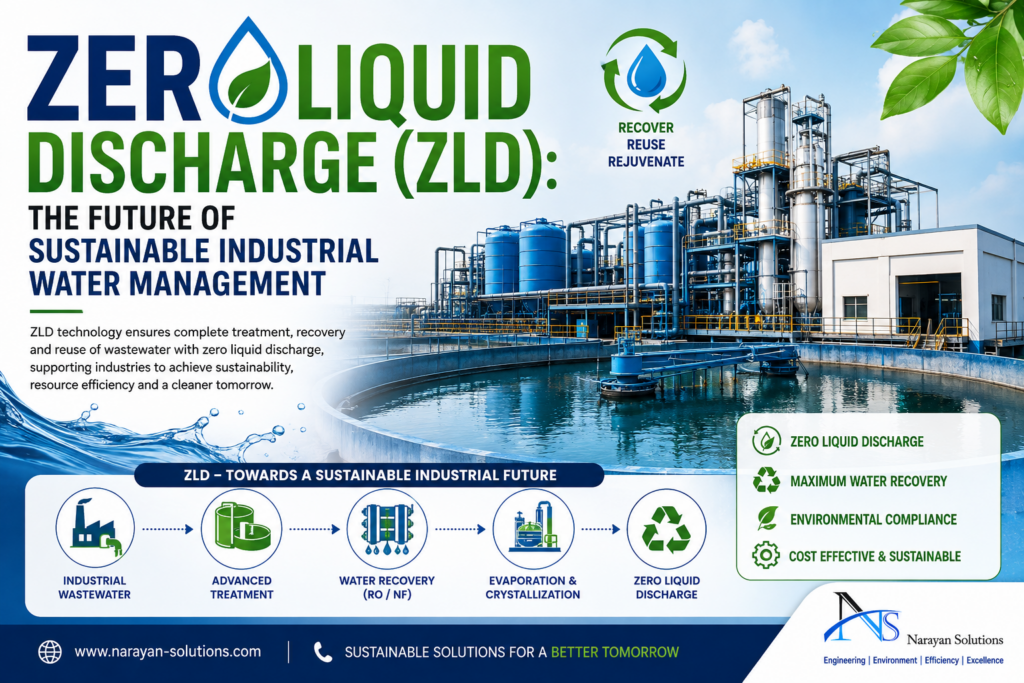
Zero Liquid Discharge (ZLD) is an advanced wastewater treatment approach designed to eliminate liquid effluent discharge. The process treats wastewater, recovers reusable water and manages the remaining concentrated contaminants as solids.

A typical ZLD system may combine several treatment technologies based on wastewater quality and project requirements.

These technologies can include:

  • Effluent Treatment Plant (ETP)
  • Physico-chemical treatment
  • Biological treatment
  • Ultrafiltration (UF)
  • Reverse Osmosis (RO)
  • Nanofiltration (NF)
  • Multiple Effect Evaporator (MEE)
  • Evaporation and crystallization

The exact treatment process depends on wastewater characteristics, recovery targets and applicable environmental requirements.

How Does a ZLD System Work?

A ZLD plant generally follows several treatment and water-recovery stages.

1. Primary and Secondary Treatment

First, wastewater undergoes suitable physical, chemical and biological treatment. This stage helps reduce suspended solids, organic matter and other contaminants.

Proper pretreatment is important because it protects downstream membrane and evaporation systems.

2. Advanced Filtration

After initial treatment, advanced membrane technologies such as UF, NF and RO can be used.

These processes help separate dissolved contaminants and recover a significant portion of the water for potential reuse.

3. Water Recovery and Reuse

One of the main advantages of ZLD is water recovery.

Recovered water can potentially be reused for suitable industrial applications, depending on its quality. This can reduce freshwater consumption and improve overall water efficiency.

4. Concentrate Management

The remaining concentrated wastewater contains higher levels of dissolved salts and other contaminants.

Depending on the system design, evaporation and crystallization technologies can further process this concentrate. The goal is to eliminate the remaining liquid stream and manage the resulting solids appropriately.

Key Benefits of Zero Liquid Discharge

Reduced Liquid Discharge

The primary objective of Zero Liquid Discharge technology is to minimize or eliminate liquid effluent discharge from the industrial facility.

This can help industries manage wastewater more responsibly.

Better Water Conservation

Water recovery allows industries to reuse treated water instead of relying entirely on freshwater sources.

As a result, ZLD can support long-term sustainable water management.

Wastewater Recycling

A properly designed ZLD system can convert wastewater into a potential source of reusable process water.

This supports the transition from a traditional “treat and discharge” model to a more efficient “treat, recover and reuse” approach.

Improved Environmental Management

By reducing liquid discharge, ZLD can help industries strengthen their environmental management practices and reduce the potential impact of wastewater on surrounding resources.

Support for Regulatory Requirements

Environmental requirements vary by industry and location. Certain sectors and projects may have specific wastewater treatment, reuse or ZLD requirements.

Therefore, ZLD system design should always consider applicable regulations and consent conditions.

Which Industries Can Benefit from ZLD?

Industrial wastewater treatment using ZLD can be considered for industries with high water consumption, significant wastewater generation or strict discharge requirements.

Potential applications include:

  • Textile and dyeing industries
  • Pharmaceutical industries
  • Chemical manufacturing
  • Distilleries
  • Tanneries
  • Food and beverage industries
  • Pulp and paper industries
  • Other water-intensive manufacturing facilities

However, ZLD is not a one-size-fits-all solution. A detailed assessment of wastewater quality, flow, water balance and recovery requirements is necessary before selecting the appropriate system.

ZLD and Sustainable Industrial Water Management

Industries are increasingly looking for ways to reduce freshwater consumption while improving wastewater management.

ZLD technology supports this goal by combining wastewater treatment, water recovery and concentrate management within an integrated system.

However, a ZLD plant is more than a single treatment unit. It requires careful engineering based on:

  • Wastewater characteristics
  • Daily and peak flow
  • Chemical composition
  • Required water recovery
  • Energy consumption
  • Available space
  • Operating conditions
  • Applicable environmental requirements

A well-designed system can improve water recovery while supporting reliable and efficient industrial operations.

Why Choose Narayan Solutions for ZLD Solutions?

Narayan Solutions provides customized industrial wastewater treatment and ETP solutions for different industrial requirements.

Our services can include advanced treatment, plant upgrading, operation and maintenance support, and customized wastewater management solutions.

A properly engineered ZLD system can help industries improve water recovery, reduce liquid discharge and develop a more sustainable approach to industrial water management.

For customized ZLD solutions in India, consult Narayan Solutions to evaluate your wastewater treatment and water-recovery requirements.

Conclusion

Zero Liquid Discharge (ZLD) is becoming an important approach to sustainable industrial water management.

By combining wastewater treatment, membrane filtration, water recovery, evaporation and concentrate management, ZLD can help suitable industries reduce liquid discharge and reuse valuable water.

As freshwater conservation becomes increasingly important, investing in the right ZLD plant and industrial wastewater treatment system can support environmental responsibility, resource efficiency and long-term operational sustainability.

Looking for a Customized ZLD Solution?

Contact Narayan Solutions for expert consultation, system design, installation, upgrading and AMC support for industrial wastewater treatment and ZLD systems.

Contact Us

📍 Address: Plot No. 47, R.R. Plot, Prasanta Sur Nagar, Nonadanga, Chowbaga, Kolkata – 700105

📞 Call: 9831038044 / 7044093759 / 7044037375

🌐 Website: https://narayan-solutions.com

📩 Email: solutionnarayan@gmail.com


Frequently Asked Questions

1. What is Zero Liquid Discharge (ZLD)?

ZLD is an advanced wastewater management approach designed to eliminate liquid effluent discharge by recovering reusable water and managing concentrated contaminants.

2. Is ZLD mandatory for every industry?

No. ZLD requirements depend on the industry, location, environmental regulations and applicable consent conditions.

3. What technologies are used in a ZLD plant?

Depending on the wastewater, a ZLD plant may use ETP treatment, UF, RO, NF, evaporation, MEE and crystallization.

4. What are the main benefits of ZLD?

The main benefits include water recovery, wastewater recycling, reduced liquid discharge and improved sustainable water management.

5. Is ZLD suitable for small industries?

Suitability depends on wastewater characteristics, flow, recovery requirements, infrastructure and techno-economic feasibility. A detailed assessment is recommended before selecting a ZLD system.


ZLD system | Zero Liquid Discharge system | ZLD plant | industrial wastewater treatment | sustainable water management | wastewater recycling | ETP plant | industrial water treatment | ZLD technology | water recovery system | ZLD solutions in India