
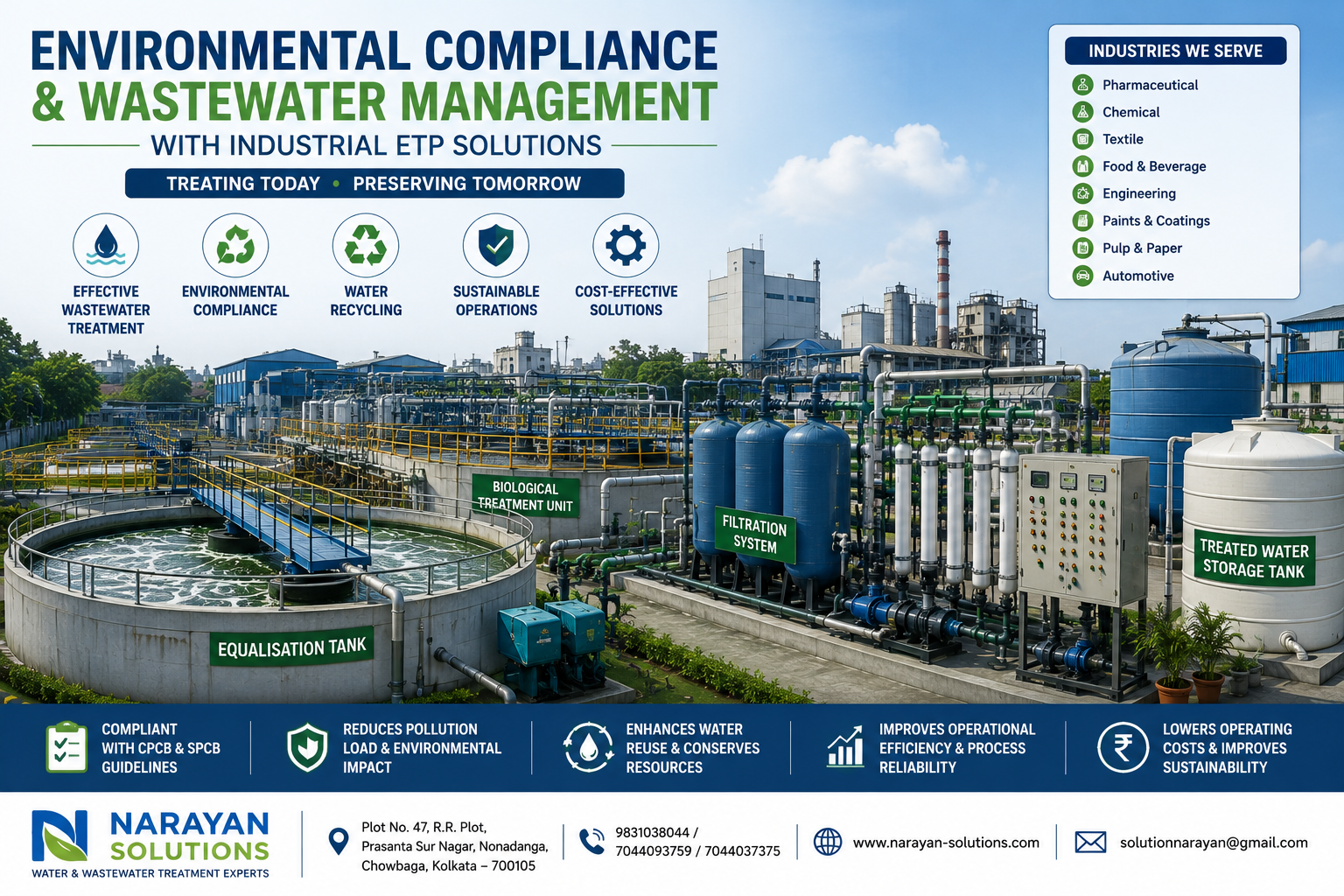
Industrial development is essential for economic growth, but manufacturing and processing activities can generate wastewater containing suspended solids, organic matter, oils, chemicals, nutrients and industry-specific contaminants. Effective environmental compliance and wastewater management are therefore essential for responsible industrial operations.
A properly designed Effluent Treatment Plant (ETP) can help industries treat process wastewater, reduce pollutant loads and manage treated effluent according to applicable requirements and intended reuse or discharge conditions.
In West Bengal, industries may need to obtain appropriate Consent to Establish (CTE) and Consent to Operate (CTO) from the West Bengal Pollution Control Board (WBPCB), depending on their category and activity. WBPCB’s current service information includes CTE and CTO processes for Red, Orange and Green industries in specified circumstances.
Why Wastewater Management Matters for Industries
Industrial wastewater should not be treated as an unavoidable by-product. With the right treatment strategy, it can be managed as part of a broader environmental and resource-management programme.
Poorly managed effluent can create risks for water bodies, soil, surrounding communities and industrial operations. Effective treatment helps industries control pollution and establish a more systematic approach to wastewater handling.
For industries operating in West Bengal, regulatory compliance should be considered during project planning, plant design, operation and expansion.
What Is an Effluent Treatment Plant?
An Effluent Treatment Plant (ETP) is a treatment system designed to process industrial wastewater before appropriate discharge or reuse.
Depending on the industry and wastewater characteristics, an ETP may combine:
- Screening and preliminary treatment
- Collection and equalisation
- Oil and grease removal
- pH correction
- Coagulation and flocculation
- Primary clarification
- Biological treatment
- Secondary clarification
- Filtration and tertiary treatment
- Disinfection
- Sludge handling
The treatment configuration should be based on wastewater analysis, flow rate, pollutant characteristics and the required treated-water quality.
Understanding Environmental Compliance
Environmental compliance is more than simply installing an ETP. Industries should understand the permissions, standards, monitoring requirements and operating conditions applicable to their particular activity.
WBPCB documentation for Consent to Operate applications includes information such as project details, manufacturing processes, effluent-management plans and current effluent test reports.
Some WBPCB consent conditions also require suitable effluent-treatment measures and compliance with applicable effluent standards before discharge.
Therefore, industries should maintain proper records, conduct required testing and ensure that the treatment system is operated and maintained consistently.
Key Steps for Effective Industrial Wastewater Management
1. Analyse the Wastewater
Start with laboratory testing. Parameters such as pH, BOD, COD, TSS, oil and grease, nutrients, dissolved solids and industry-specific pollutants can help determine the appropriate treatment process.
2. Measure Flow Correctly
ETP capacity should be based on actual wastewater generation, including average and peak flows. Incorrect capacity calculations can lead to inefficient treatment or unnecessary capital costs.
3. Select Appropriate Technology
There is no single ETP technology suitable for every industry. Pharmaceutical, chemical, textile, food-processing, engineering and other industries can have very different wastewater characteristics.
4. Plan for Sludge Management
Treatment generates sludge that requires appropriate handling, storage, transportation and disposal according to applicable requirements.
5. Monitor Treated Effluent
Regular monitoring helps identify changes in treatment performance and provides useful information for operational decision-making and compliance management.
6. Maintain the ETP Properly
Preventive maintenance of pumps, blowers, dosing systems, filters, electrical equipment and other components is important for consistent plant performance.
Water Recycling: Moving Beyond Treatment
Modern wastewater management increasingly focuses on water recovery and recycling.
Where technically feasible and permitted, appropriately treated wastewater may be reused for suitable non-potable applications such as gardening, cooling, cleaning or other utility requirements.
Water recycling can help industries reduce freshwater consumption and improve resource efficiency. However, the treatment process must be designed according to the quality required for the intended reuse application.
Why Choose a Customised ETP Solution?
A customised ETP considers the industry’s:
Wastewater Characteristics + Flow Rate + Treatment Requirements + Site Conditions + Reuse Objectives + Operating Capacity
This approach can help improve treatment performance and operational practicality.
For industries searching for an ETP plant in Kolkata, selecting an experienced wastewater-treatment partner is particularly important because local site conditions, regulatory requirements and project-specific wastewater characteristics need to be considered.
Why Choose Narayan Solutions?
Narayan Solutions provides customised water and wastewater treatment solutions designed around project requirements.
Its solutions include ETP systems, wastewater recovery, customised treatment solutions, installation support and AMC services. For businesses seeking industrial wastewater treatment and ETP solutions in Kolkata, professional design and long-term support can help create a more reliable wastewater-management system.
Industrial Wastewater Compliance Checklist
Before commissioning or upgrading an ETP, industries should review:
- Wastewater quantity and characteristics
- Applicable environmental permissions
- Required effluent-quality parameters
- ETP capacity and treatment technology
- Sludge-management arrangements
- Water-reuse opportunities
- Effluent monitoring and testing
- Preventive maintenance schedules
- Operator training
- Documentation and compliance records
Conclusion
Effective environmental compliance and wastewater management require a combination of appropriate technology, responsible operation, regular monitoring and awareness of applicable regulatory requirements.
An efficiently designed ETP can help industries manage wastewater responsibly while supporting pollution control, water conservation and sustainable industrial growth.
For customised ETP and industrial wastewater treatment solutions in Kolkata, consult Narayan Solutions to evaluate your wastewater characteristics, treatment requirements and water-recycling objectives.
Contact Us
📍 Address: Plot No. 47, R.R. Plot, Prasanta Sur Nagar, Nonadanga, Chowbaga, Kolkata – 700105
📞 Call: 9831038044 / 7044093759 / 7044037375
🌐 Website: https://narayan-solutions.com
📩 Email: solutionnarayan@gmail.com
Industrial Wastewater Management | Environmental Compliance | Effluent Treatment Plant | ETP Solutions | Industrial ETP Plant | Wastewater Treatment Plant | ETP Plant Kolkata | Industrial Wastewater Treatment | Water Recycling Solutions