
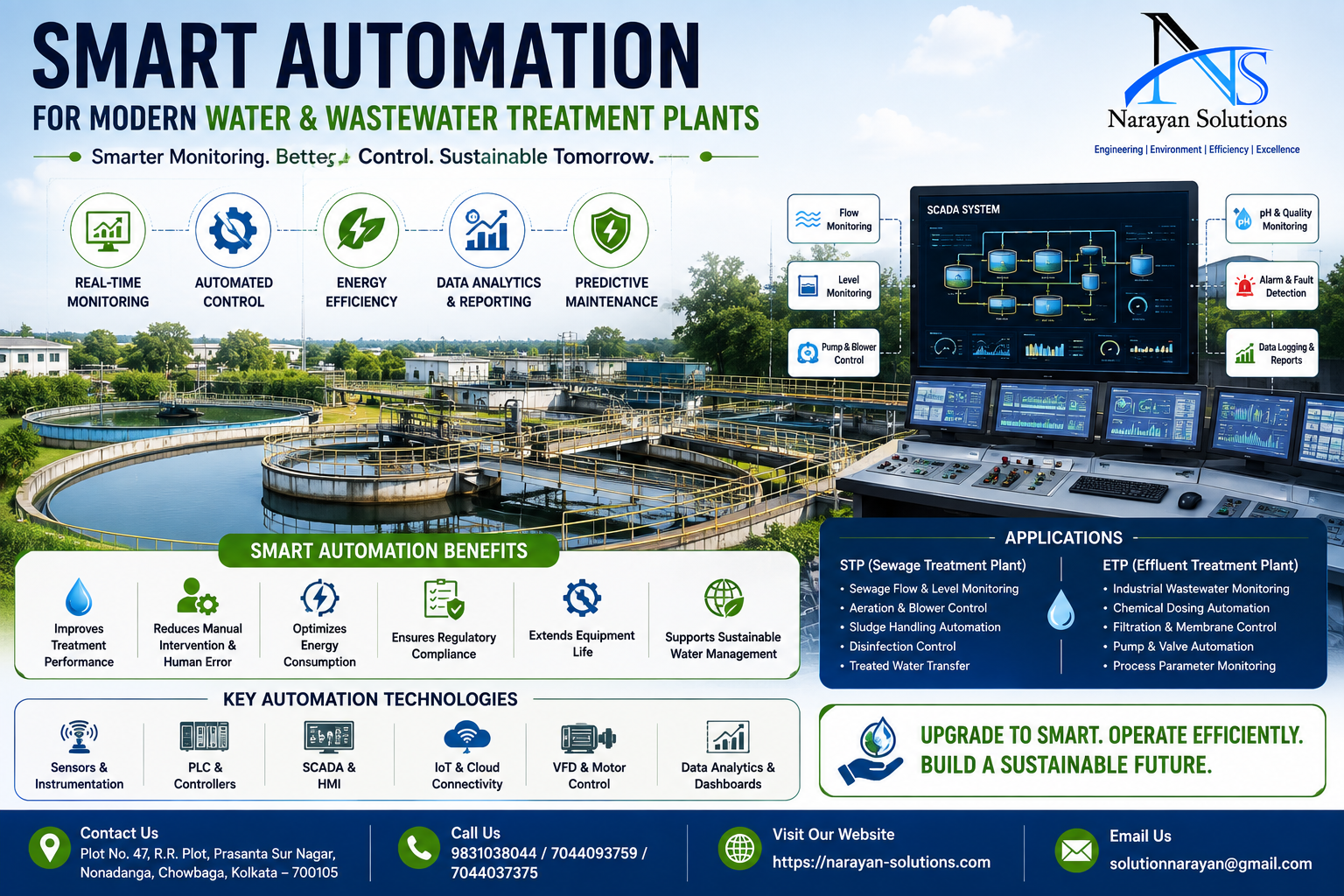
Water and wastewater treatment plants are becoming smarter, faster and more efficient. Industries and facilities are adopting automation to improve reliability, reduce manual work and manage resources effectively.
Traditional treatment plants often depend on manual monitoring and operator intervention. Today, smart automation in water and wastewater treatment is changing this approach.
Sensors, PLCs, SCADA systems, data dashboards and automated controls provide real-time information. As a result, operators can monitor plant conditions, control equipment and respond quickly to process changes.
What Is Smart Automation in Water Treatment?
Smart water treatment combines sensors, control systems and software to monitor and manage treatment processes automatically.
A modern automated treatment plant may use:
- Online sensors
- Flow meters
- Level sensors
- pH and turbidity monitoring
- PLC-based controls
- SCADA systems
- Human-machine interfaces (HMI)
- Variable frequency drives (VFDs)
- Automated dosing systems
- Data logging and dashboards
Together, these technologies improve plant visibility and simplify routine operations.
How Automation Improves Treatment Plant Performance
1. Real-Time Monitoring
Real-time monitoring is one of the biggest benefits of wastewater treatment automation.
Sensors continuously collect information about flow, tank levels and water-quality parameters. Operators can view this information through SCADA and monitoring platforms.
This makes it easier to identify changes quickly and take corrective action when required.
2. Better Process Control
Automated systems can control pumps, valves, blowers and other equipment according to programmed conditions.
For example, the system can respond to changes in tank levels or process requirements. This reduces unnecessary manual intervention and supports more consistent plant operation.
3. Improved Energy Efficiency
Pumps, blowers and aeration systems can consume considerable energy.
Water treatment plant automation can help optimize equipment operation according to actual process requirements. VFDs can also help control motor speed where appropriate.
Better control can support efficient energy use while maintaining required treatment performance.
4. Automated Chemical Dosing
Many treatment processes require controlled chemical dosing.
An automated dosing system can use process measurements and programmed set points to regulate chemical addition. This can improve dosing consistency and help avoid unnecessary chemical consumption.
The correct control method depends on the treatment process, wastewater characteristics and required water quality.
5. Faster Fault Detection
Smart monitoring can identify abnormal conditions such as:
- Pump failures
- High tank levels
- Equipment faults
- Unusual operating conditions
- Changes in process parameters
Early warnings allow operators to investigate problems before they become major failures.
This can support preventive maintenance and reduce unexpected downtime.
6. Better Data and Performance Analysis
Modern automation systems can record plant data continuously.
Historical information helps operators identify trends, compare performance and monitor equipment condition.
This data can also support better maintenance planning and process optimization.
Smart Automation for STP and ETP Plants
Automation can be used in both smart STP and smart ETP systems.
For Sewage Treatment Plants (STPs), automation can help monitor and control:
- Sewage flow
- Tank levels
- Aeration
- Pump operation
- Sludge handling
- Disinfection
- Treated-water transfer
For Effluent Treatment Plants (ETPs), automation can support:
- Industrial wastewater monitoring
- Chemical dosing
- Filtration
- Membrane treatment
- Pump and valve control
- Process parameter monitoring
The right level of automation depends on plant capacity, treatment technology, wastewater characteristics and operational requirements.
Smart Automation and Predictive Maintenance
Automation can make maintenance more proactive.
By monitoring equipment status and operating conditions, plant teams can identify unusual patterns early. These warning signs may indicate developing equipment problems.
Instead of waiting for a breakdown, operators can schedule inspections and maintenance at the right time.
This approach can improve equipment reliability and help reduce avoidable downtime.
Why IoT Matters in Wastewater Treatment
IoT wastewater treatment systems can connect sensors, equipment and monitoring platforms to improve data collection and plant visibility.
With suitable infrastructure, operators can access important operational information from centralized dashboards. This can make it easier to monitor performance and respond to changing conditions.
IoT-based monitoring can be particularly useful for facilities that require continuous supervision and detailed operational records.
Why Cybersecurity Matters
As treatment plants become more connected, cybersecurity becomes increasingly important.
SCADA systems, PLCs, networks and remote-access platforms should be protected with suitable security measures.
Facilities should consider secure access, network protection, backups, software updates and appropriate user permissions when implementing automated systems.
Why Choose Narayan Solutions?
Narayan Solutions provides customized water and wastewater treatment solutions for industrial, commercial and institutional requirements.
Automation can be integrated into new treatment plants or included as part of suitable STP and ETP upgrades.
Depending on project requirements, solutions may include:
- Process monitoring
- Automated controls
- Equipment integration
- Plant upgrading
- STP and ETP solutions
- Operation and maintenance support
Every automation system should be designed around the actual treatment process and operational requirements of the facility.
Conclusion
Smart automation in water and wastewater treatment is helping modern facilities achieve more reliable and data-driven operations.
From real-time monitoring and automated control to energy optimization, fault detection and predictive maintenance, automation offers several opportunities to improve plant management.
As industries focus more on water conservation and operational efficiency, industrial wastewater management is becoming increasingly technology-driven.
The right combination of automation, monitoring and treatment technology can help facilities build smarter, more efficient and sustainable water infrastructure.
Looking for Smart Water & Wastewater Treatment Solutions?
Contact Narayan Solutions for customized STP, ETP, WTP, automation, upgrading, operation and maintenance solutions.
Contact Us
📍 Address: Plot No. 47, R.R. Plot, Prasanta Sur Nagar, Nonadanga, Chowbaga, Kolkata – 700105
📞 Call: 9831038044 / 7044093759 / 7044037375
🌐 Website: https://narayan-solutions.com
📩 Email: solutionnarayan@gmail.com
Frequently Asked Questions
1. What is smart automation in wastewater treatment?
Smart automation uses sensors, PLCs, SCADA, software and automated equipment controls to monitor and manage wastewater treatment processes.
2. What is SCADA in water treatment?
SCADA is a monitoring and control system that collects operational data and helps operators supervise connected treatment equipment.
3. Can automation improve STP performance?
Yes. Suitable automation can support real-time monitoring, process control, equipment management, fault detection and consistent operation.
4. Can existing STPs and ETPs be automated?
In many cases, existing plants can be upgraded with suitable sensors, PLCs, control panels, VFDs and SCADA systems. Feasibility depends on the existing plant design and equipment.
5. Can automation improve energy efficiency?
Automation can help optimize equipment operation and energy use. Actual results depend on the existing system, equipment efficiency, process conditions and control strategy.
smart water treatment | wastewater treatment automation | SCADA water treatment | automated wastewater treatment plant | smart STP | smart ETP | water treatment plant automation | IoT wastewater treatment | industrial wastewater management | wastewater monitoring system