
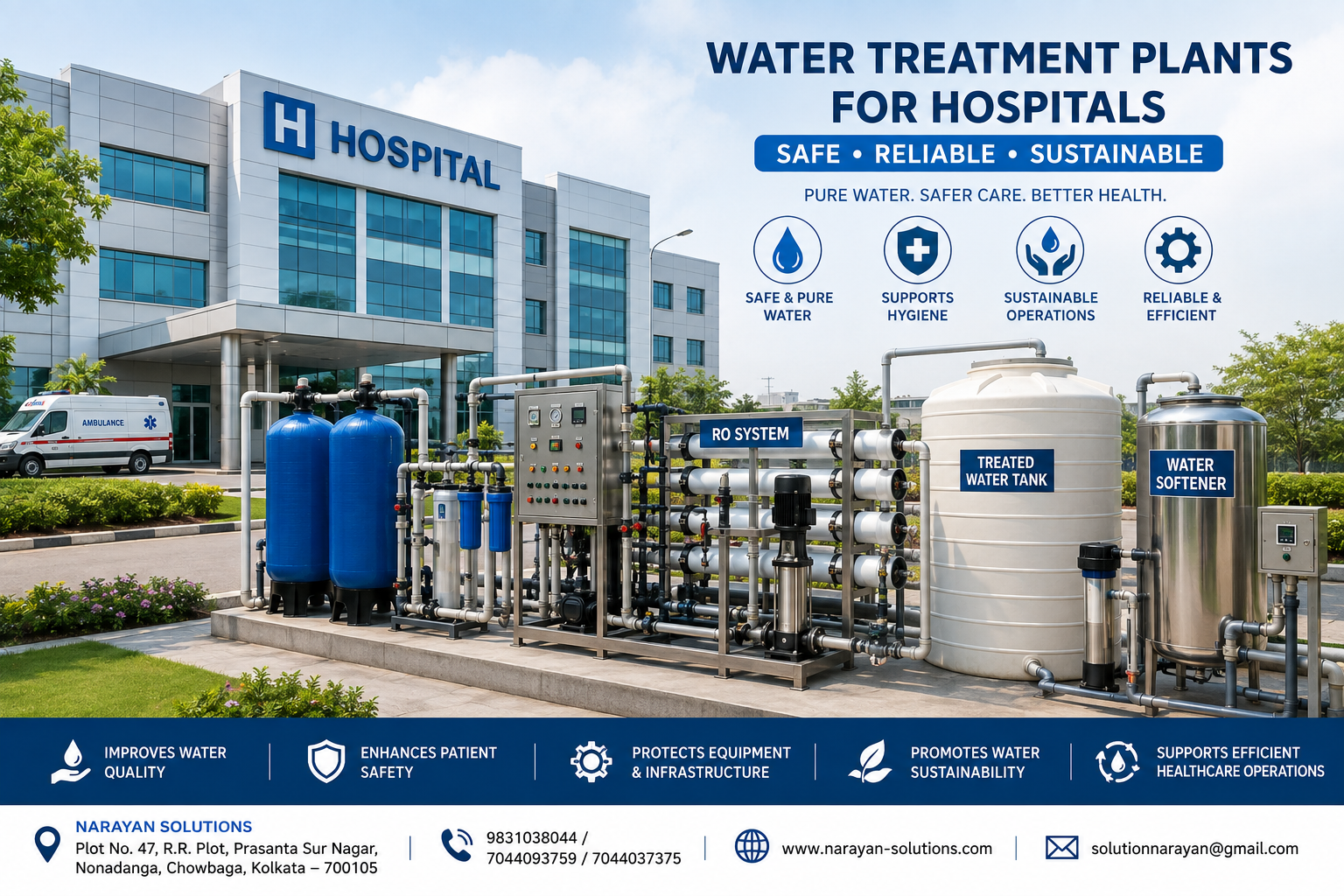
Hospitals require a dependable supply of appropriately treated water for patient care, hygiene, cleaning, kitchens, laundry, laboratories, cooling systems and other essential operations. Because water quality can directly affect healthcare environments, hospitals need a carefully planned approach to water treatment and water management.
The World Health Organization identifies water, sanitation and hygiene (WASH) services as essential components of safe, quality healthcare and infection prevention.
A properly designed water treatment plant for hospitals can help improve incoming water quality and provide treated water suitable for specific applications.
Why Hospitals Need Water Treatment Plants
Hospital water sources may contain suspended particles, hardness, dissolved minerals, organic contaminants or microorganisms depending on the source and local conditions. A treatment system helps address the specific characteristics of the incoming water.
The treatment process should be based on water-quality testing, intended use, required water quality and applicable standards. In India, IS 10500 provides specifications for drinking water quality, including physical, chemical and microbiological parameters.
For healthcare facilities, water treatment should therefore be considered as part of a broader water-safety and facility-management strategy rather than simply as an equipment purchase.
Common Components of a Hospital WTP
The exact configuration depends on source-water quality and application, but a hospital Water Treatment Plant (WTP) may include:
- Raw Water Storage: Provides a controlled supply for treatment.
- Pressure Sand Filter: Helps reduce suspended particles and turbidity.
- Activated Carbon Filter: Helps reduce certain organic compounds, odour and colour.
- Water Softener: Reduces hardness where required.
- Micron Filtration: Provides additional particulate filtration.
- Ultrafiltration: Can provide membrane-based removal of fine particles and microorganisms, depending on the system.
- Reverse Osmosis (RO): Reduces dissolved salts and other contaminants when required.
- UV or Disinfection: Provides an additional microbial-control step where appropriate.
- Treated Water Storage: Maintains treated-water availability for designated applications.
- Pumping and Control Systems: Support reliable distribution and system operation.
Not every hospital requires all these stages. A customised design is generally more effective because treatment requirements vary according to the source and end use.
Applications of Water Treatment in Hospitals
A well-planned hospital WTP can support different areas of healthcare operations, including:
Drinking and Food Preparation
Where water is intended for drinking or food preparation, treatment should be designed to meet the applicable drinking-water requirements.
Patient Care and Hygiene
Reliable water quality is essential for hand hygiene, cleaning and routine hospital operations. WHO states that functioning WASH services are crucial for quality care and infection prevention.
Laundry and Housekeeping
Hospitals can consume significant quantities of water for laundry and cleaning. Appropriate treatment can help manage source-water issues that may affect these operations.
Laboratories and Specialised Applications
Some laboratories and specialised equipment may require water of specific quality. Additional purification stages may be necessary depending on the application and equipment manufacturer’s requirements.
Cooling and Utility Systems
Treated water may also be required for selected utility applications such as cooling systems, subject to the required water-quality specifications.
Benefits of a Hospital Water Treatment Plant
1. Improved Water Quality
A properly selected treatment process can address specific physical, chemical and microbiological water-quality concerns.
2. Reliable Water Supply
Hospitals operate continuously, making reliable water availability an important operational requirement.
3. Better Hygiene Management
Safe and reliable water supports cleaning, hand hygiene and other essential healthcare-facility activities. WHO considers WASH services fundamental to quality healthcare.
4. Equipment Protection
Treating hard or mineral-rich water can help reduce scaling and protect certain plumbing, heating and utility equipment.
5. Sustainable Water Management
Water treatment can be combined with wastewater treatment and reuse strategies to reduce unnecessary freshwater consumption where technically appropriate.
How to Select the Right WTP for a Hospital
Before selecting a hospital water treatment plant, consider:
- Source of raw water
- Daily and peak water demand
- Raw-water laboratory analysis
- Required treated-water quality
- Drinking-water requirements
- Hospital size and occupancy
- Specialised medical applications
- Available installation space
- Energy and chemical consumption
- Automation and monitoring
- Maintenance requirements
- Future capacity expansion
A professional water-treatment assessment helps determine the appropriate treatment stages, capacity and operating requirements.
Sustainable Hospital Water Management
Modern hospitals can go beyond water purification by developing an integrated water-management strategy. This can include WTP, STP, wastewater recycling, rainwater management and efficient water-use practices.
Treated wastewater, where appropriate and permitted, may be considered for suitable non-potable applications. This approach can help hospitals reduce freshwater demand while improving overall resource efficiency.
WHO’s recent guidance on healthcare-facility WASH also emphasizes sustainable and climate-resilient infrastructure and informed selection of water and sanitation technologies.
Why Choose Narayan Solutions?
Narayan Solutions provides customised water and wastewater treatment solutions based on project requirements.
For hospitals seeking a Water Treatment Plant in Kolkata, the right solution can be developed around source-water quality, required capacity, intended applications, available space and long-term operational needs.
From treatment-system planning and installation support to operation and AMC requirements, a reliable treatment partner can help hospitals maintain a dependable water-management system.
Conclusion
A Water Treatment Plant for hospitals is an important part of reliable healthcare infrastructure. From drinking water and hygiene to specialised applications and utility operations, different hospital departments may require different levels of water quality.
By combining appropriate treatment technology, regular water-quality monitoring, efficient operation and sustainable water-management practices, hospitals can build a safer and more reliable water system.
If you are planning a hospital WTP in Kolkata or elsewhere in India, consult a professional treatment-system provider to assess your water source and application requirements.
Contact Us
📍 Address: Plot No. 47, R.R. Plot, Prasanta Sur Nagar, Nonadanga, Chowbaga, Kolkata – 700105
📞 Call: 9831038044 / 7044093759 / 7044037375
🌐 Website: Narayan Solutions
📩 Email: solutionnarayan@gmail.com
Hospital Water Treatment Plant | WTP for Hospitals | Water Treatment Plant Kolkata | Hospital WTP Solutions | Hospital Water Purification | RO Plant for Hospitals | Industrial WTP | Sustainable Water Management