
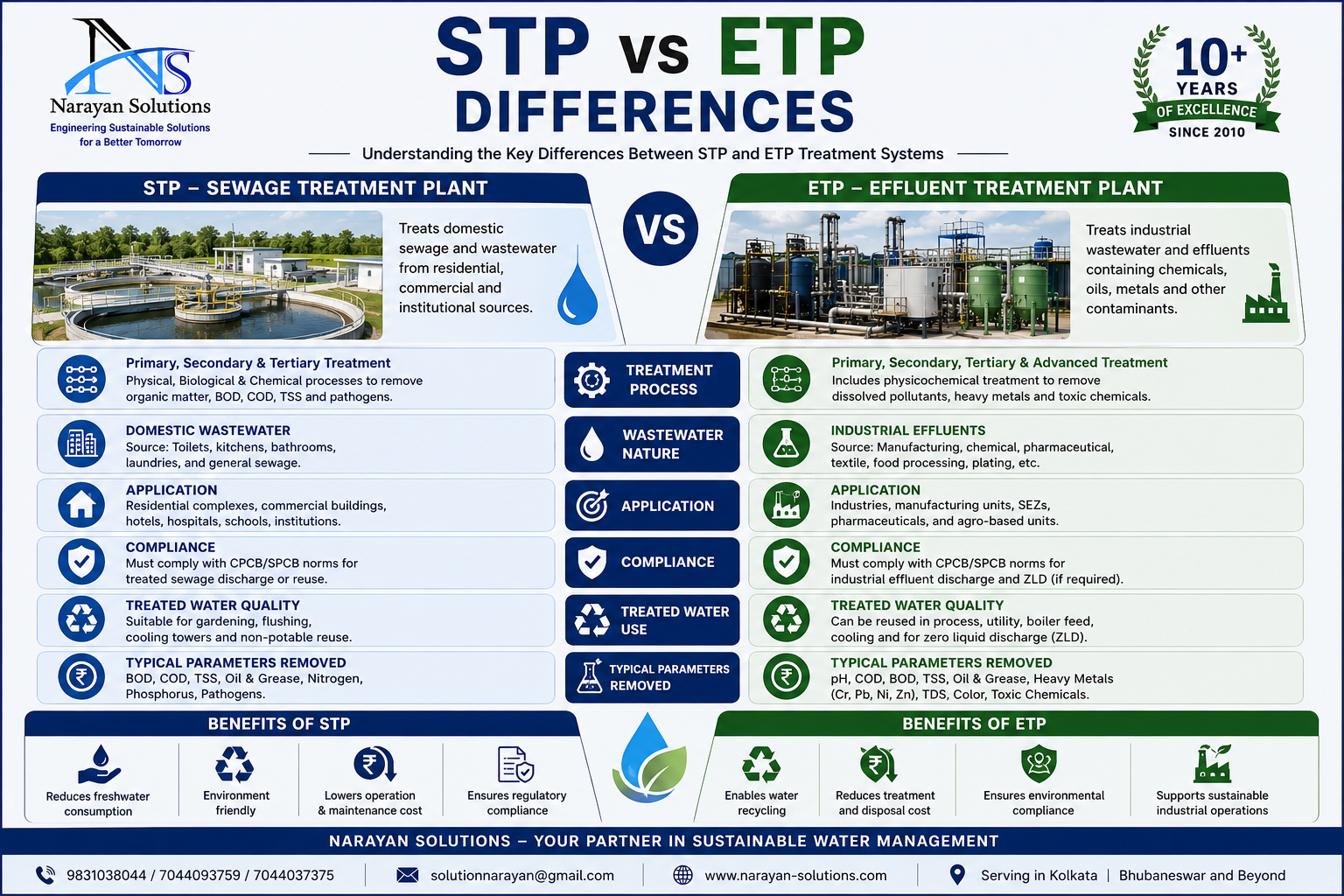
Choosing the Right Wastewater Treatment System
Water treatment plays a crucial role in protecting the environment, conserving resources, and supporting business operations. Today, industries, commercial properties, and residential communities must manage wastewater responsibly to meet environmental standards and reduce their impact on natural resources.
As regulations become stricter, businesses need reliable wastewater treatment solutions. Two of the most common systems are Sewage Treatment Plants (STPs) and Effluent Treatment Plants (ETPs). Although both systems treat wastewater, they serve different purposes and handle different types of contaminants. Therefore, understanding their differences helps organizations make informed decisions and avoid costly mistakes.
Moreover, selecting the correct treatment system improves compliance, reduces operating expenses, and supports long-term sustainability goals.
What is a Sewage Treatment Plant (STP)?
A Sewage Treatment Plant, or STP, treats domestic wastewater generated from homes, offices, hotels, hospitals, schools, and commercial buildings. Its main purpose is to remove organic matter, suspended solids, bacteria, and harmful microorganisms before the water is discharged or reused.
After treatment, facilities can safely reuse water for several non-drinking applications, including:
- Gardening
- Landscape irrigation
- Toilet flushing
- Cooling towers
- General cleaning
As a result, organizations reduce freshwater consumption and lower overall water costs.
Where Are STPs Commonly Used?
Many facilities install STPs to manage domestic wastewater effectively. Common applications include:
- Residential Apartments
- Housing Complexes
- Hotels and Resorts
- Hospitals
- Educational Institutions
- Corporate Offices
- Shopping Malls
- Commercial Buildings
How Does an STP Work?
Most sewage treatment plants follow a step-by-step process to clean wastewater efficiently.
Primary Treatment
First, screens and settling tanks remove large solids, debris, and floating materials.
Biological Treatment
Next, beneficial microorganisms break down organic pollutants naturally.
Clarification
Following biological treatment, the system separates remaining suspended particles from the water.
Disinfection
Finally, operators disinfect the treated water to eliminate bacteria and harmful pathogens before reuse or discharge.
Benefits of Installing an STP
Organizations choose STPs for several important reasons:
✔ Supports water recycling
✔ Reduces freshwater usage
✔ Helps meet environmental regulations
✔ Lowers utility expenses
✔ Promotes sustainable property management
What is an Effluent Treatment Plant (ETP)?
While STPs handle domestic wastewater, ETPs treat industrial wastewater generated during manufacturing and production activities. Industrial wastewater often contains chemicals, oils, heavy metals, dyes, solvents, and other pollutants that require specialized treatment.
Consequently, industries use ETPs to remove harmful contaminants before releasing or reusing wastewater.
Common Pollutants Found in Industrial Wastewater
Industrial effluent may contain:
- Chemicals
- Heavy Metals
- Oils and Grease
- Toxic Compounds
- Dyes
- Solvents
- Manufacturing Residues
Because these pollutants are more complex, industries require advanced treatment technologies to achieve safe discharge standards.
Industries That Need ETP Systems
Many manufacturing sectors depend on ETP systems, including:
- Chemical Manufacturing Plants
- Textile Industries
- Pharmaceutical Units
- Food Processing Industries
- Paint Manufacturing Facilities
- Engineering Industries
- Metal Processing Plants
How Does an ETP Work?
Unlike domestic sewage treatment, industrial wastewater treatment involves multiple specialized processes.
Chemical Coagulation
Initially, treatment chemicals help separate suspended contaminants from wastewater.
Neutralization
After that, operators adjust the pH level to create suitable treatment conditions.
Biological Treatment
Subsequently, biological processes break down biodegradable pollutants.
Sludge Management
At the same time, the system processes and manages sludge generated during treatment.
Advanced Filtration
In the final stage, filtration systems remove remaining contaminants before discharge or reuse.
Benefits of Installing an ETP
An ETP provides several operational and environmental advantages:
✔ Controls industrial pollution
✔ Supports regulatory compliance
✔ Enables water reuse
✔ Reduces environmental risks
✔ Improves sustainability performance
STP vs ETP: Major Differences
| Feature | STP | ETP |
|---|---|---|
| Wastewater Type | Domestic Sewage | Industrial Effluent |
| Source | Residential & Commercial Facilities | Manufacturing Industries |
| Treatment Complexity | Moderate | High |
| Chemical Usage | Minimal | Significant |
| Pollutants Removed | Organic Matter & Pathogens | Chemicals, Oils & Heavy Metals |
| Operating Cost | Lower | Higher |
| Compliance Standard | Municipal Regulations | Pollution Control Board Norms |
| Maintenance Requirement | Moderate | Extensive |
Which System Is Right for Your Facility?
The best choice depends on the type of wastewater your facility generates.
STP Is Ideal For:
- Residential Complexes
- Commercial Buildings
- Hotels
- Hospitals
- Educational Campuses
- Corporate Offices
Since these facilities mainly generate domestic sewage, an STP usually offers the most effective solution.
ETP Is Ideal For:
- Manufacturing Plants
- Chemical Industries
- Textile Units
- Pharmaceutical Facilities
- Food Processing Plants
- Engineering Industries
In contrast, these facilities produce industrial effluent that contains specialized contaminants requiring advanced treatment methods.
Why Choosing the Right System Matters
Selecting the right wastewater treatment system provides several long-term benefits.
Better Regulatory Compliance
Most importantly, organizations can meet environmental regulations and discharge standards more effectively.
Lower Operating Costs
Additionally, properly designed systems reduce maintenance expenses and improve efficiency.
Stronger Environmental Protection
Effective treatment minimizes pollution and protects rivers, lakes, and groundwater resources.
Greater Water Conservation
Furthermore, treated water can support multiple reuse applications, reducing dependence on freshwater sources.
Improved Business Sustainability
Ultimately, responsible wastewater management strengthens sustainability initiatives and supports long-term business growth.
Future Trends in Wastewater Treatment
The wastewater treatment industry continues to evolve rapidly. Today, organizations increasingly adopt advanced technologies to improve treatment efficiency and reduce operating costs.
Popular innovations include:
- MBBR Technology
- SBR Treatment Systems
- Zero Liquid Discharge (ZLD)
- Smart Monitoring Systems
- Automated Treatment Plants
- Industrial Water Recycling Solutions
Furthermore, digital monitoring and automation help operators improve performance while reducing maintenance requirements. As environmental standards continue to evolve, businesses will rely more heavily on these advanced treatment technologies.
Conclusion
Both STPs and ETPs play essential roles in wastewater management. However, each system serves a different purpose. An STP treats domestic sewage from residential and commercial properties, whereas an ETP manages industrial wastewater containing chemicals and complex pollutants.
Therefore, understanding the difference between STP and ETP helps organizations select the most suitable solution for their operations. In addition, the right system improves compliance, supports water conservation, reduces environmental impact, and lowers long-term operating costs. Ultimately, investing in the correct wastewater treatment system supports sustainable growth and responsible resource management.
FAQs
- What is the main difference between STP and ETP?
STPs treat domestic sewage, while ETPs treat industrial wastewater containing chemicals and pollutants. - Which industries require an ETP?
Chemical, pharmaceutical, textile, food processing, engineering, and manufacturing industries commonly require ETP systems. - Can treated water from an STP be reused?
Yes. Treated STP water can be reused for flushing, gardening, landscaping, and cooling applications. - Why are ETP systems more complex than STPs?
Industrial wastewater contains chemicals, heavy metals, oils, and toxic substances that require advanced treatment processes. - Is an STP mandatory for commercial buildings?
Many commercial developments require STPs to meet environmental regulations and wastewater management standards. - Can industries use both STP and ETP systems?
Yes. Many industrial facilities install both systems to separately treat domestic sewage and industrial effluent. - Which treatment system is more cost-effective?
The answer depends on the wastewater type. STPs generally have lower operating costs, while ETPs require more advanced treatment and maintenance.
Contact Us
📞 Call: 9831038044 / 7044093759 / 7044037375
🌐 Website: https://narayan-solutions.com
📩 Email: solutionnarayan@gmail.com
Difference Between STP and ETP | Sewage Treatment Plant | Effluent Treatment Plant | Industrial Wastewater Treatment | STP vs ETP | Wastewater Treatment Solutions | Industrial ETP Solutions | Sewage Water Treatment | Zero Liquid Discharge | Pollution Control Solutions | Industrial Water Treatment | STP for Residential Complex | ETP for Industries | Sustainable Water Treatment | Wastewater Management System | Water Recycling Solutions | Environmental Engineering Solutions | Narayan Solutions